Denise Sullivan

Author, Arts & Cultural Reporter and Worker

Songs for the Occupation

Tuesday May 15 saw the release of Occupy This Album, a 4-disc collection of 99 topical songs, with all proceeds going toward supporting the Occupy movement. I have not yet read a review of the album that makes any sense to me, which is reason for me to get busy listening and to write one of my own (though if you have read anything thoughtful and well-rendered, please bring it to my attention). Until I’ve prepared my piece, I thought I’d repost a column I wrote last fall titled Songs for the Occupation—a kind of call for topical songs and a roll call of musicians who declared themselves 99 percent friendly from the start. No doubt the good people at Paste won’t mind if I post the previously published article here, since it pertains to a good cause and all.

NOVEMBER 2011—Early last month, when the Occupy Wall Street movement was still building, an East Bay punk rocker asked me what I thought people had hoped to achieve by occupying city centers and marching in the streets. Since the movement is without spokespeople, it wasn’t my place to say, but personally, I was taking it as a good sign that people are finally coming together in the name of social and economic justice. “I think it’s time to bring compassion back into style” I said. “Good luck with that,” he replied, and no, he wasn’t being sincere, which took me aback for about a minute until I remembered that punk rock is supposed to be snotty, cynical and nihilistic and he was just doing his part to keep the franchise alive.
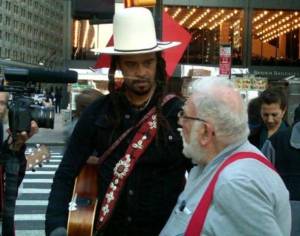
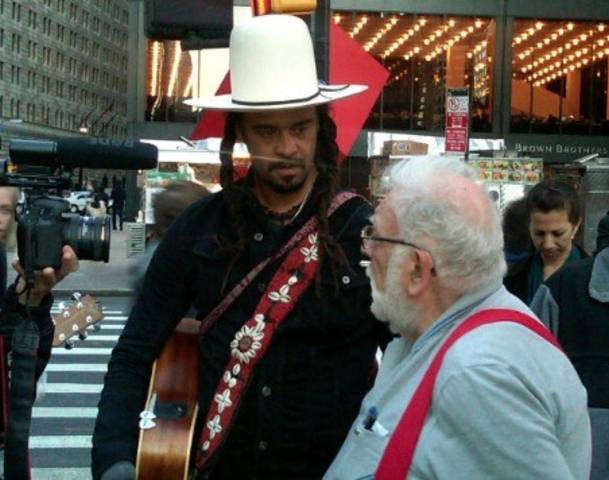
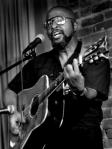
Michael Franti at OWS

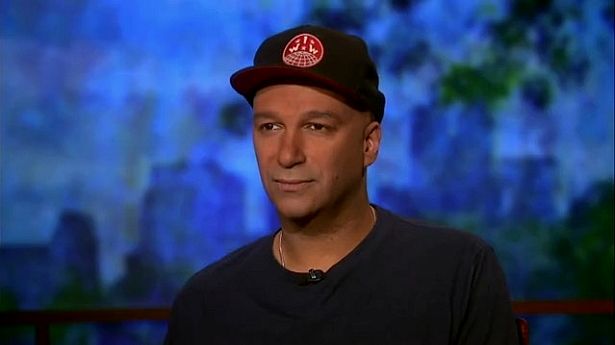
It must be said that plenty of punk-rock people are as interested in building things anew as they are in tearing down the old down, and that music people of all orientations have always brought soul, sounds and heart to social and political movements. So far, only the true lionhearts of contemporary music have turned out for the Occupation, though each week brings more surprises: Ever-ready artist/activist Michael Franti showed up in the first week of October to “Yell Fire.” Talib Kweli, longtime resident in the trenches of conscious hip hop, dropped by to drop some rhymes and weigh in with a powerful new piece he called “Distractions”: “Skip the religion and the politics and head straight for the compassion, everything else is a distraction,” he rapped. Tom Morello, who as The Nightwatchman, shows up with his ax wherever injustice is served, came out to lead a chorus of “This Land is Your Land,” the old Woody Guthrie song that’s easy enough to sing along to, even if you don’t know the words. And the generally apolitical Jeff Mangum of Neutral Milk Hotel delivered a rare, impromptu set of songs to the delight of park dwellers. In particular, the line “we know who are enemies are” from the fan favorite, “Oh Comely,” drew cheers from the crowd. Mangum’s appearance, if not his topically unspecific songs, provided the people with entertainment and support, the kind of unique companionship that only a song can provide in the cold, cold night. Sure the protesters have each other for company—for now—but as rousts and arrests increase, winter sets in and the drum circle decibels rise, the park may see fewer folks willing to stand strong, and that means fewer professional musicians out there, leading the singalongs.

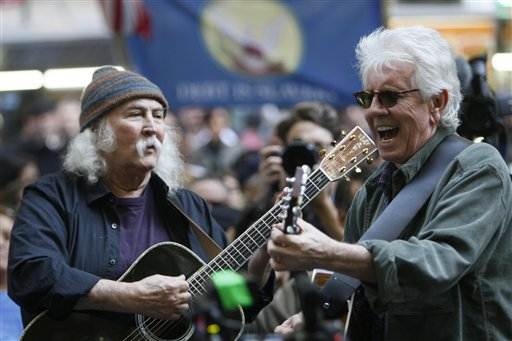
“Our idea was to go down and raise their spirits,” said David Crosby, who with Graham Nash sang for the Zuccotti Park crowd in early November. “What music is doing is unifying the people, bringing them together,” Nash told Rolling Stone.

“Everybody has a point, everybody has an idea everybody has a perspective on the world,” said rapper Lupe Fiasco when asked about musician participation in OWS. Stressing that celebrities are just like the rest of the occupiers, except in a higher tax bracket, he noted, “The leader is Occupy; it is the movement.”

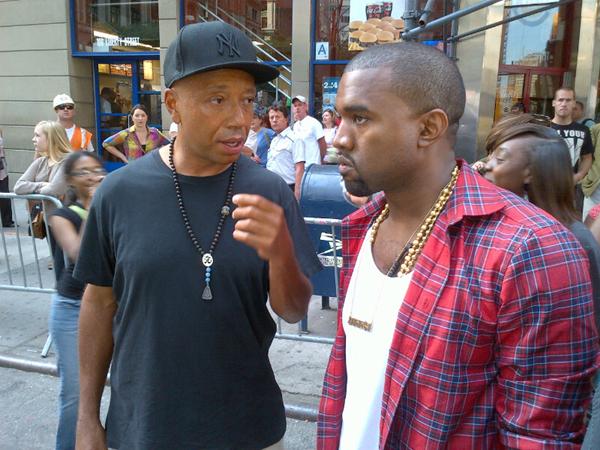
Simmons and West, OWS

Hip hop organizer and mogul Russell Simmons is among those on the street with the 99 percent; part of his role there has been shepherding visitors like the Rev. Al Sharpton and Kanye West through the Zuccotti Park encampment. During the week of West’s and Jay-Z’s Madison Square Garden concerts in November, Simmons was pictured with Jay-Z wearing an “Occupy All Streets” t-shirt, manufactured by his line, Rocawear (it’s unclear where the proceeds are going, though one can only hope the merch is made in America).

The Occupy movement for social and economic equality has been called by scholar Cornel West a “democratic awakening,” while those less enamored with the movement call it a disorganized mess. Call it what you like but whether the occupiers maintain their ground at the park or are forced to leave it, songs—the kind with roots, that are built to last—will provide some sustenance through the winter. Truth is, the people can always use a few more good tunes (or at least some remixes of old ones) to sing on the long march home.

Back in the salad days of protest—the ’60s civil rights, free speech, anti-war and black power movements—rewriting the old songs with the intention of forging something new was common practice—it’s called folk tradition. Rewriting and reviving spirituals for the secular world—or at least a world in which all faiths and traditions get equal respect—was an area mined by Pete Seeger, who along with Joan Baez, helped to turn “We Shall Overcome,” into an unofficial anthem of the Civil Rights Movement (most memorably, Baez sang it at the 1963 historic March on Washington; Seeger recently sang it at OWS).

Originally based on the gospel song, “I’ll Overcome Some Day,” composed by the Rev. Charles Albert Tinley and dating back to the African American Methodist Episcopal Church of the early 1900s, “We Shall Overcome” has changed shape through the years; also contributing to the version as we know it were elements of the spiritual “We’ll Overcome (I’ll Be All Right)”, another hymn from the immediate post-slavery period. But it wasn’t long after its arrival in church hymnals that “I’ll Overcome Some Day” was picked up by striking miners and laborers who went on to use it throughout their organizing fights in the ’20s, ’30s and ’40s. Sung by miners in the North as well as tobacco workers in the South, “We Shall Overcome” became a staple at the Highlander Folk School, the training ground for civil rights workers. Highlander teacher Guy Carawan helped to popularize the song among the forming Student Nonviolent Coordinating Committee (SNCC) in 1960 and the song was spread far and wide by Seeger who changed up the verses a bit. By and by, the melody to “We Shall Overcome” came closer to echoing another slave time spiritual, “No More Auction Block” (once sung by Paul Robeson and Odetta and used by Bob Dylan as the tune for “Blowin’ in the Wind”) than Tinley’s “I Shall Overcome” did. In essence, two folk standards emerged from one spiritual.
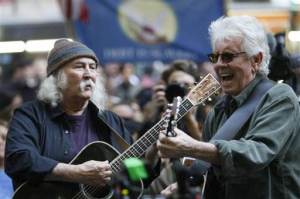
Crosby and Nash, OWS

But more than its fairly tame melody, the strength of “We Shall Overcome” lies in its extraordinarily bold lyrical affirmations: We are not afraid/the truth shall make us free/we shall live in peace. These sentiments are as ripe for the current moment, as they were when the United Farm Workers used it in their fight for their rights, as when South Africans sang it in their struggle against Apartheid, and when Czechs sang it during the Velvet Revolution that overthrew communism. “We Shall Overcome” has been deployed in struggles in India and Ireland. It’s been sung by Bruce Springsteen and was recorded for his Seeger Sessions; Seeger, now 92, is still singing it. Though I’d say it’s time for someone from the youngest generation of American singer/songwriter/activists to adopt and adapt it, and lead the singalong. “We Shall Overcome” needn’t be consigned to folk’s moldy or buttoned-up past; rather, it’s protest gold, a song that hasn’t lost its value for over 50 years and counting. If it seems strange, update it. If it seems square, give it a beat (djembe will work just fine). But traditional songs need to get sung and sung loud, as if your life depended on them because in fact there are people whose do: Overseas wars cost not only money but lives; poverty is killing people here at home. Workplace and housing discrimination, poor schools, environmental degradation, job disintegration—these are just some of the grievances that will end up in songs as the movement keeps moving on.

Dr. Martin Luther King Jr. knew what music could bring to a non-violent protest effort: he asked gospel great Mahalia Jackson to accompany him and Harry Belafonte to help organize his efforts. Belafonte’s life is a demonstration of just how important a role a singer can play in effecting change as well as how education in the arts can save young lives (Belafonte tells his own story in the new film, Sing Your Song, and new book, My Song: A Memoir). Nina Simone; Curtis Mayfield; Bob Marley; Peter, Paul and Mary; Sam Cooke; and many, many more singers and musicians contributed to positive social change and quite possibly political change with their music. You may laugh at this notion of change, like the East Bay punker I talked to last month did, but it’s not so funny when you think about Oakland: People from all walks of life, all genders, all religious backgrounds, colors and sexual orientations, there and elsewhere, are standing up to the indignities served up to their communities: It’s one nation time—under a groove.

So here’s to you, Occupiers and musicians: To Michael Franti, Jeff Mangum, Pete Seeger, Tom Morello, Joan Baez, Crosby and Nash, Joseph Arthur and Talib Kweli in NYC, Boots Riley in Oakland and Ozomatli in L.A. The hearts of Joe Strummer, Nina Simone, Phil Ochs and Paul Robeson are on your sleeves now. Every movement, from abolition to women’s suffrage to labor and civil rights has its songs, and this moment in time has its songs too. Thank you—to the singers and your songs—songs that one night might be the only thing between the darkness, cold, tear gas and rubber bullets raining on someone’s soul. Thank you for occupying—so that we shall all overcome, someday.


Filed under: Occupy Wall Street, Songs for the Occupation, , , , , , , ,

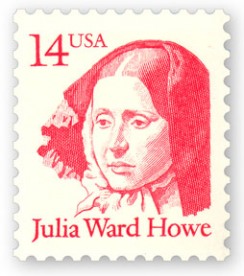
Julia Ward Howe: Another Mother For Peace

About once a year you hear the name Julia Ward Howe: She gave us Mother’s Day, declaring it first in 1870. Howe was primarily a writer and an activist; her work included poetry and lyrics, and she rallied for the abolition of slavery, women’s rights, and peace. Born in 1819 in New York City, most famously she adapted the lyrics to “America” to fit the women’s suffrage cause. In the Civil War era, in folk tradition, she rewrote the words to the existing songs “Canaan’s Happy Shore” and “Say Brothers, Will You Meet Us” as “Battle Hymn of the Republic” (which also provides the melody of abolitionist anthem, “John Brown’s Body,” circulating at the same time). In her memoir, Howe wrote of the poem coming to her in her sleep, and rising to transcribe the words: “I scrawled the verses almost without looking at the paper,” she wrote.

A century later, the song was repurposed by Len Chandler for the Civil Rights Movement as “Move On Over.”

You promise us the vote then sing us We Shall Overcome

Hey but John Brown knew what freedom was he died to win us some

And the Movement’s moving on

One of the singer-songwriters on the early ’60s Greenwich Village folk scene (one of his original melodies was borrowed by Bob Dylan), Chandler stuck with topical songs and movement building, and went on to put “Move On Over” to work in the anti-Vietnam War effort, updating it again and performing it for troops throughout Southeast Asia. What a striking example of how a song can travel the miles, from one movement to another, to another, without losing authority or missing a beat of its heart—or its intention to preserve humanity, and the life of some mother’s daughter or her son.  Glory Hallelujah, Len Chandler and Julia Ward Howe: Your mothers would be proud. And to all the mothers—including my own–along with the stepmothers, grandmothers, aunts, sisters, and others it takes to get the job done: Happy Mother’s Day. Love and thanks for birthing and raising your children and helping them through.

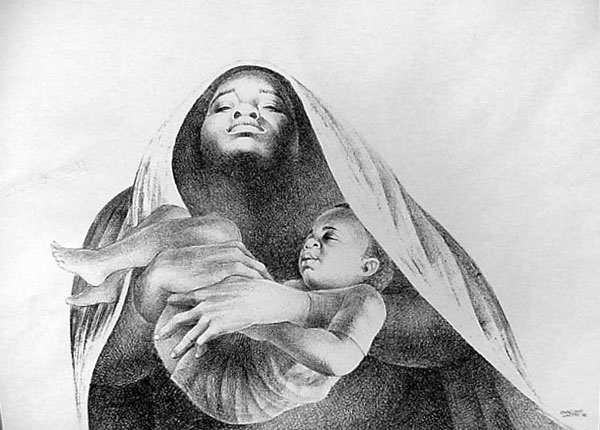
I thought you mothers (and others) would like this image–it’s a lithograph by Charles White (1918-1979). The Chicago-born artist made his name mid-career and later, largely on the work created and shown in Los Angeles during the ’60s. This work from 1976 is titled “I Have A Dream,” and was included alongside White’s politically-charged and socially conscious-works in the Hammer Museum exhibit, Now Dig This! (I’ve heard it will begin traveling soon). I think moms will also dig this well-known song but lesser-seen clip of  “What’s Going On?” by Marvin Gaye, performing at the Save the Children concert event in 1973.

More on Len Chandler, Julia Ward Howe and Marvin Gaye in Keep on Pushing

Filed under: Keep On Pushing, , , , , , , , , ,

Para Todos Mis Amigos Latinos: Muchas Gracias por El Rock ‘n’ Roll

It all started with Ritchie Valens and “La Bamba” in 1958, though it would be another decade before Santana took Tito Puente’s “Oye Como Va” and freaked it out in 1970. Los Lobos brought Spanish language to LA punks with “Anselma” in the early ’80s and to the masses in 1987 with a remake of “La Bamba”; in 2002, they tore it up Chicano style with “Good Morning Aztlán.” Of course, these names of Latino rock royalty can twist a phrase en español—it is their birthright. But what about los gringos without Latino roots who’ve attempted to bring a little Mexican vibe to their rock ‘n’ roll? And the bands that feature lesser known Mexican-Americans or who are conquistadors of south-of-the-border sound? Well, they are the subject of this Cinco de Mayo post, claro que si.

There are any number of starting points I could choose to begin the story of Latin rock and the use of Spanish language in rock ‘n’ roll, but since I’m not a scholar of the stuff and just an admiradora, I’ll apologize upfront for any mismanagement of details, mangling of the language, and my Anglo-centric survey of the music. Let’s just say for the sake of ease we start with 1948 and Don Tosti’s recording of “Pachuco Boogie”, a swingin’ tune about the rebellious zoot-suiters featuring a conversation or street rap in Caló, the urban dialect of the Pachuco subculture. The Pachucos donned the zoot suit and started a ’40s fashion and attitude riot that asserted individuality and anger in the face of having been stripped of a cultural identity. What, you are asking yourself, does this have to do with music? Well, Southwestern Chicanos adopted the baggy trouser/knee-length jacket uniform that had previously been seen on the Harlem jazz scene, and Don Tosti earned the nickname “the Godfather of Latin Rhythm and Blues.” Alongside Lalo Guerrero, “the Father of Chicano Music,” who also sang of Pachuco life as well as farm laborers’ rights, Tosti opened the door for an ethnocentric brand of music to cross into the mainstream (“Pachuco Boogie” was a massive seller), though it wouldn’t be until the late ’60s that the Chicano Movement would come to organize in the name of cultural identity. “Suavecito”, the 1972 hit by Malo (the group led by Santana’s brother Jorge), is an example of Caló y Latin rhythms coming together in one classic R&B/rock ballad. But what happened between “Pachuco Boogie” and the day when Santana threw down at Woodstock before even releasing a debut album?

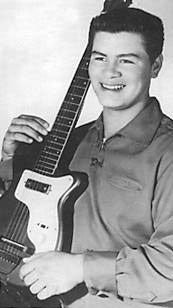
Well, that would be the invention of Latin rock by California son, Ritchie Valens, a rocker whose “Come On, Let’s Go” and “Donna” are ’50s standards, but who happens to be most remembered for the music of his cultural heritage. As we know, the music died on February 3, 1959 when Buddy Holly, the Big Bopper, Valens, and the pilot died in a plane crash in Iowa, yet “La Bamba”, the el hefe of Spanish language rock songs, lives on. Starting out as a hundreds year-old Mexican folk song, Valens rocked it up and delivered a three-chord wonder that eventually any garage or punk-rock band could play. The Plugz, an LA band by way of El Paso, featuring Tito Larriva and Charlie Quintana, self-released their cranked-up version of “La Bamba” in 1981. The Plugz also recorded two long-playing rare classics, Electrify Me and Better Luck, before morphing into the Cruzados and then eventually going their separate ways, but not before their “El Clavo y La Cruz” and “Hombre Secreto” (as in “Secret Agent Man”) gave the right touch to Repo Man, the punky midnight movie about “the LA experience.” Larriva went on to work as a solo act and got into movie scoring; Quintana did a stint drumming for Dylan and continues to work with the big names in rock. Speaking of Dylan, aside from his film Masked and Anonymous featuring a wicked Spanish-language version of “Like a Rolling Stone”, as well as a Lobos version of “On a Night Like This”, Dylan is an on-the-record fan of Sir Douglas Quintet, famous for Augie Meyers’ Vox Continental organ sound.

Meyers met Doug Sahm as kids in San Antonio, Texas; when their band got together, they were among the handful of US groups who brought the spirit of the British Invasion (English musicians doing American music), back into the hands of Americans by tricking the public into thinking they were playing British-styled music like the Beatles and the Stones, rather than American music by Americans. Ha! So Sir Doug had officially added the Tex-Mex sound to the American music mix, while Sahm would also go on to sing of the border and other Mexican concerns (“Michoacan”). In later years, Sahm and Meyers would also join forces with Mexican-American rock and genre-straddling songwriter Freddie Fender and accordion virtuoso Flaco Jimenez as the Texas Tornados. But it all began with the Sir Douglas Quintet’s greatest hit, “She’s About a Mover”, released in 1965.

The Farfisa organ sound and the count-off uno, dos, one-two, tres cuatro would become recognized around the world that same year as the opening to “Wooly Bully” by Sam the Sham and the Pharaohs. Led by a Texas-born son of Mexican immigrants, Domingo (Sam) Samudio, the song is about nothing really and was said to be named after his cat. Domingo worked as an itinerant musician and reportedly as a carny before forming the Pharaohs, who took their name from Yul Brynner because he looked tough as the character in The Ten Commandments, one of those epic 1950s Bible movies. “Wooly Bully” became a staple of the frat-rock genre though it was more distinctive than just serving as the soundtrack to Animal-House-style hijinks. The song spent an incredible 18-week stand on the charts, and by the end of 1965, it was named Billboard magazine’s Number One Record of the Year and had helped dislodge singles on the charts by the aforementioned pesky British bands of the era. Sam the Sham’s “Li’l Red Riding Hood” was certainly another fine moment for the band, but it lacked the Tex-Mex organ sound that would crop up on the great singles of the ’60s made by another legendary group of Mexican-Americans: “96 Tears” by Question Mark & the Mysterians, who hailed from Michigan and were fronted by Question Mark aka Rudy Martinez and featured a teenaged organ player, Frank Rodriguez, Jr. The organ riffing would also inspire the group’s “Can’t Get Enough of You, Baby.” In 1998, Smash Mouth from the Mexican-American-populated San Jose, California, had a hit with the song alongside their hit remake of “Why Can’t We Be Friends?” by War, a mixed-race funk band whose big hit “Low Rider” was a hats-off to cruisin’, Chicano style.

Of course, when it comes to cruisin’ Chicano style, the band for that is East LA’s Thee Midniters. Known for their instrumental jam “Whittier Boulevard” (Let’s take a trip down Whittier Boulevard—Arriba, arriba!), the band and their especially soulful singer Willie Garcia, better known as Little Willie G, was a big inspiration to the future members of Los Lobos. The song was a natural to cover for Los Straitjackets, the contemporary (mostly) all-instrumental band that performs in Mexican wrestler masks.

Okay, so copping a Spanish name and wearing a mask does not make a Mexican rocker. But by virtue of using the article “los” in their names, Los Straitjackets, as well as Texas rockers Los Lonely Boys, are filed in American record stores with the other “los bands,” like Los Bravos, the rock group from Spain whose 1966 hit, “Black Is Black”, did not contain a word of Spanish. Nor to my knowledge did the Zeros, the Mexican-American band from San Diego, ever sing in Spanish, though as members of the class of ’77,
they are distinguished as first-wave punk rockers; they also sprung Robert Lopez, aka El Vez, the Mexican Elvis. Somewhere, there exists a single of their anthem “I Don’t Wanna” backed with “Li’l Latin Lupe Lu”, a cover of a Righteous Brothers song made famous by Mitch Ryder.

I have only scratched the surface of the Latino influence on rock and never even got to disco. There is so much to uncovers, from Devendra Banhart’s musings en español on Cripple Crow and the Mission District’s #1 son, Jerry Garcia (that is if you don’t count figure #1a, Santana). I had planned to wax on about Beck Hansen’s Mexican-American neighborhood origins and the exact definition of un perdedor as heard in “Loser.” I wanted to touch upon that great Spanish-lover, Joe Strummer, whose Mexico City childhood allowed him to open his corazón to the Spanish-speaking world, and they to him. I had hoped to remind you to remember to forget U2’s lame-o uno, dos, tres, catorce countdown to “Vertigo”, but who am I to talk when all I can offer are my own gabacha sign-offs, ay, caramba y que lástima. Yo no soy una roquera, lo siento. Pero, in the hands of the Mars Volta, Ozomatli, Zack de la Rocha, y todos los músicos, La Raza rocks on.

(A good 99 percent of this column published  in Crawdaddy!, some couple of years ago…).


Filed under: Mexican American/Latino Rock, , , , , ,

It Was A Good Day

Today marked 20 years since the LA uprising of 1992. Ignited by the acquittal of the four police officers that had brutally beaten motorist Rodney King, the riot was not surprising given the history of police brutality and misconduct in the under-served community. South Central Los Angeles had been under pressure for at least four decades at the time of the six-day riot: Segregation, lack of services, and poor relations between residents and the law were the usual elements that conspired to combust in urban unrest.

Four years before, the matters of racial profiling, gang violence and more were brought to the world’s attention when in 1988, N.W.A. delivered Straight Outta Compton, a collection of raps concerning life on the street there.  Broadcasting their tales of hard and violent times in South Los Angeles, the group caught the attention of the FBI, which in short order made investigative efforts toward shutting them down. Records were pulled from shelves and stickered with warning labels, though eventually an entire industry grew from similarly styled graphic tales of survival fights and criminal scenarios. Ice-T’s sometimes cautionary crime-rapping tales were also associated with the birth of the west coast gangsta boom and he caught his share of resistance too. As it turned out, there was a gigantic market for this reality-art, and as the insurgent sound of N.W.A. went  on to define the early era of gangsta rap, the group’s tussles with the law began to echo the lifestyles described in their songs.  Here is N.W.A.’s least inflammatory rap, wrapped around the track, “Express Yourself” by Charles Wright & the Watts 103rd St. Rhythm Band:

N.W.A. and gangsta rap would forever alter hip hop. The music’s aims remain embroiled in controversy and even conspiracy theory, yet it is undeniably a moneymaker.  In Keep on Pushing, I attempt to untie some of the threads that run through the art of hip hop, commerce, and the dilemma posed by gangsta rap as part of a larger investigation. Shining a light in the corners of music history where the sounds and singers converge with law enforcement, and where incendiary art confronts the force of the market, is part of a larger unfolding exploring the tradition of songs calling for change.  I specifically included the music of the late ‘80s Los Angeles in the text to illustrate how hip hop broadcast the news from America’s urban centers in a way that the mainstream media was not able to manage.  Hip hop, including the earliest examples of gangsta rap,  is a demonstration that there are some songs that go beyond simple entertainment or artistic expression; rather, they have the potential to inspire, record otherwise unwritten histories, deliver the news, and give voice to those who may otherwise go unheard.

“Why get mad at the brother bringing the news?  Get mad at the person making it happen,” said Tupac Shakur in the early ‘90s. Anyone who knew hip hop or the conditions in South Central at the time would not have been surprised to hear there was a riot going on in 1992; an uprising was inevitable given the conditions. N.W.A. were simply reporters, the eyes and ears, that brought the noise from Compton to the world.  They  were not the first, nor will they be the last to bring their experience from South Central to a wider audience through a song.

In the 1920s till the 1950s, Central Avenue was the hub of the LA R&B and jazz scenes, springing such giants as Lionel Hampton and Johnny Otis, Eric Dolphy and Charles Mingus.  These were artists whose commitment to music and the fight for racial equality extended beyond entertainment.  As a one-time member of Hampton’s band, Central Ave. regular, avant garde piano stylist Horace Tapscott founded the Pan Afrikan People’s Arkestra in 1961.  A vocal opponent of racism and advocate for social change, in the ‘60s, Tapscott worked with young artists in coffeehouses and community centers of Watts, the creative center for South LA’s artists and its progressive politics in that decade.  Today the spirit of community action and harmony through art lives in Leimert Park.  Immediately following the ’92 uprising, some of the area’s visionary citizens banded together to create a safe haven for the preservation of jazz, poetry, theater and visual arts, providing community space for the still under-served and post-riot, imperiled community. The independent film, Leimert Park documents the transition and the extraordinary rebirth of arts and culture in South LA (the name currently in rotation for the area formerly known as South Central, as in South of Central Ave.) since 1992. Here’s a clip from the film, featuring the Pan Afrikan People’s Arkestra, with vocalist Dwight Trible.  The group celebrated its 50th anniversary of being last year with a series of concerts.

And so I conclude this entry with a thank you to the artists and advocates, the poets, writers, filmmakers, dancers, actors and musicians of South Los Angeles, for documenting your place, your time and your lives—for extending your art and your hearts—to the world.  I truly hope that this April 29, 20 years on, was a good day in the neighborhood.

Filed under: Hip Hop, Keep On Pushing, , , , , , , ,

When Record Store Day Meets Earth Day, it’s time for The Esso Trinidad Steel Band

In honor of this weekend’s most auspicious collision of Record Store Day and Earth Day,  Saturday and Sunday respectively, I decided to reprise a story about where environmentalism meets record collecting, which as it happens is also the most-read article here at denisesullivan.com.  The Day Van Dyke Parks Went Calypso, originally appeared in the pages of Crawdaddy! in 2009, 40 years after the Santa Barbara oil spill and the birth of the environmental movement, and upon the occasion of the  re-reissue of Parks’ long out-of-print productions for calypso artists, the Esso Trinidad Steel Band, and the Mighty Sparrow. Parks had a goal and an idea ahead of its time: To forge environmental healing through music made by instruments made of cast-off oil drums. The story further explains one man’s adventures in art and activism and begins after the clip below: Taken from a documentary on the Esso Trinidad Steel Band,you won’t find the rest of the film on youtube, though you will find it with the reissued Esso, available at your local record store.

When 80,000 barrels of oil spilled into the waters of the Santa Barbara Channel in January of 1969, the crude-splattered water, beaches, and birds along the California coast in its aftermath became the symbols of modern eco-disaster. While the ensuing public outcry helped hasten the formalization of the environmental movement as we now know it, for musician Van Dyke Parks, the spill and “the revelation of ecology,” as he calls it, was a very personal, life-altering occasion. “It changed my M.O. and changed my very reason for being,” he says. The Union Oil rig rupture in Santa Barbara made Parks go calypso.

“When I saw the Esso Trinidad Steel band, I saw myself in a Trojan Horse,” he says. “We were going to expose the oil industry. That’s what my agenda was. I felt it was absolutely essential.” From 1970 to 1975, Parks waged awareness of environmental and race matters through the music and culture of the West Indies, though in the end, “You don’t know whether to laugh or cry. That’s what makes Van Gogh go,” he says, “That’s what great art does.” Though Parks is referring directly to Esso Trinidad’s happy/sad steel drum sounds, he could just as easily be talking about his own experience during his Calypso Years.

Over a five-year period, Parks produced albums by the Esso Trinidad Steel band (1971) and Bob Dylan favorite, the Mighty Sparrow (Hot and Sweet, 1974); he also recorded his own calypso-inspired works, Discover America (1972) and Clang of the Yankee Reaper (1976). Born from his passion for popular song and launched at a time when grassroots protest was at an all-time high, Parks had every reason to believe calypso consciousness would prevail. But he hadn’t factored in the complications of taking on big oil, nor of touring the US with a 28-man steel drum corps from the Caribbean. He was unable to predict that the sessions with Mighty Sparrow would be fraught with rage, and that his efforts would earn him the enmity of Bob Marley, whose production requests he ignored in favor of calypso. And yet, you get the feeling he’d agree in one hot minute to do it all over again the exact same way if given a chance to revisit this section of his checkered recording history.  Read the rest of this entry »

Filed under: Bob Dylan, Bob Marley, Calypso, cross cultural musical experimentation, Harry Belafonte, Interview, , ,

The Ballad of Trayvon Martin

The story of 15-year-old Emmett Till of Chicago, murdered while on summer vacation in Money, Mississippi, was among the events in the mid-‘50s that mobilized the Civil Rights Movement; the tragedy was chronicled by Bob Dylan in one of his earliest songs. This clip contains a bit of background as well as the audio of the song which tells the story.

Oddly, I had long been holding tickets to attend a staged reading this week of Ifa Bayeza’s play, The Ballad of Emmett Till, in which the scene above with Mose Wright is recreated, as is mother Mamie Till’s testimony. The script was beautifully written and the acting superb, especially by Lorenz Arnell who played Till.  But I had a difficult time sitting through the show, in light of the recent events in the Sunshine State, and the information that continues to surface following the death of 17-year-old Trayvon Martin.

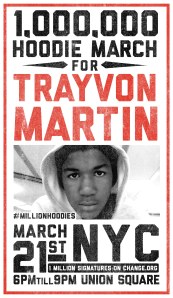
Today, as people gather in Union Square in New York City to protest the racially motivated killing of the young man in Sanford, Florida on February 26, his assailant has not yet been arrested or charged.  The rally is intended not only to shine a light on injustice—Martin’s murder was clearly a hate crime and needs to be treated with the kind of seriousness that an offense like that demands—but a plea to end the practice of racial profiling.

It’s been fifty years since Dylan sang his song about Emmett Till and it is unthinkable that it should have to be reprised as a mourning song anymore, except to be used as a history lesson. I encourage people unfamiliar with the Trayvon Martin case to read up on it and to listen to Dylan’s song. I hope that all of us will think of Martin and his family, and think of Emmett Till and his kin, and of all the Trayvon Martins and would-be Emmett Tills out there. And if there’s a freedom singer in the town square, maybe he or she will sing these verses loud, so everyone can hear them, all over this land, once and for all.

If you can’t speak out against this kind of thing, a crime that’s so unjust

Your eyes are filled with dead men’s dirt, your mind is filled with dust…

…But if all us folks that thinks alike, if we gave all we could give

We could make this great land of ours a greater place to live.

Read more on “The Death of Emmett Till” in Keep on Pushing 


Filed under: Bob Dylan, Folk, Hip Hop, , , , , ,

Ben Harper and Tom Morello Occupy LA

Filed under: Occupy Wall Street, , , ,

International Women’s Day/Which Side Are You On?

This version of  the labor standard, “Which Side Are You On?” reworked by Ani DiFranco, seemed like just the right song for today’s occasion—big in some parts of the world, though not necessarily in the USA. And yet, US Women have long been at the forefront of workers organizing, voting and other equal rights, as well as the fights to end war, poverty, and racism across the planet. DiFranco’s version of the song takes in all of our contemporary concerns and desires for change—not only for the benefit of women, but for all the people of the world.

The origin of “Which Side Are You On?” dates back to the 1930s, when the United Mine Workers of America began to organize in the mines around Eastern Kentucky in an effort to end practices like payment in scrip and pay docking toward rent in substandard housing. It was a miner’s wife, Florence Reece, who first worked up the workers’ rights classic “Which Side Are You On?” based on the hymn, “Lay the Lily Low,” to fit her experience during the miner’s strike in the ‘30s.

They say in Harlan County

There are no neutrals there

You’ll either be a union man

Or a thug for J.H. Blair

Blair was the sheriff that rousted Reece’s family during the strike among Harlan County mine workers, just one of the struggles which contributed toward the region earning its nickname “Bloody Harlan County.”  In 1969, Loretta Lynn earned a number one country hit when she sang she was proud to be a “Coal Miner’s Daughter”; the autobiographical sketch set her up for a long career during which she’d be aligned with personal stories from her hard scrabble but loving home in Kentucky coal country. Already an advocate of women’s rights in song, Lynn knew full well the contributions women had made to the mining towns of her region. In the ‘70s, workers struck again and Reece reprised the song for striking miners (preserved in this clip from Barbara Kopple’s Academy Award-winning documentary, Harlan County U.S.A.)

“Which Side Are You On?” would go on to be used as a ’60s civil rights anthem (its words adapted for the movement by songwriter Len Chandler); today it is widely considered to be a protest standard.  I am so happy to hear DiFranco sing it whenever she does, and lately she sings it often: Which Side Are You On? is also the title of her new album, released just in time to kick-off the election year.

Filed under: Coal Mining Songs, , , , ,

Now Playing: The Pointer Sisters, “Yes We Can Can”

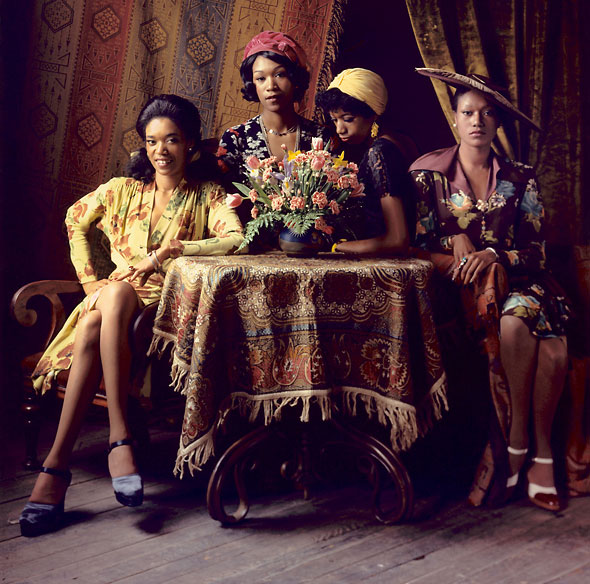
I was thinking about the Pointer Sisters today—The 1973 Pointer Sisters—and how their first album was one that rarely left my turntable that year. I was a child and mercifully I’ve held on to most of my records from then; curiously, this one’s  in pretty good condition—too good I’d say, to have belonged to a kid—which leads me to believe it’s not my original. Back then, I was in the habit of marking all my LP records with a DYMO tape sticker that said DENISE. Just like that, all caps, white letters on orange or green, sometimes red or blue though rarely yellow. But because the DYMO tape or any evidence of having been stuck by DYMO tape is missing (I like typing DYMO), I’m thinking the copy I’m holding of the Pointer Sisters’ self-titled album on the Blue Thumb label was at some point reacquisitioned, between 1973 and now.

It’s uncharacteristic of me not to know exactly when I came by a record; that’s just how it is with people who collect records (or if you collect anything, you know what I’m talking about). Obtaining the object is part of its memory, which I find is selective and often obscured by all kinds of clouds and things. But records are the proverbial madeleine that take us back to the land that time (and sometimes I) forgot; songs may come and go, but it’s the record that helps me remember.

Opening the gatefold sleeve today, I recalled a few things: How as a girl, I preferred the portraits on the outer sleeve to the stylized inner sleeve which I bitterly critiqued as “staged.” The outer sleeve was real, or so I thought, not knowing photos were taken at a thing called a photo shoot, set up by a photographer (H.B. “Herbie” Greene according to the sleeve notes) who has an assistant. Preferring the sepia-toned “authentic” 1940s styling on the outer sleeve to the glossy, Deco design on the inside, I’d pegged the Pointers as down-to-earth, regular people, not Hollywood types; they were after all local, from Oakland. This is how it should be, them living in a Victorian-styled house like the one pictured on the cover,  them dressed in ’40s casual, just as they would everyday.  I never talked to a single other kid about The Pointer Sisters first album or what they wore or how they wore it, I just know I’d still give my right arm for a dress just like the one June is wearing in the photo, perfect as it is in every way. Anyone who remembers these things like I do will tell you that baby June, the youngest Pointer, had the style thing completely locked. Such a fashion icon she was, it’s a wonder I didn’t take to wearing a turban like she did, though I think I intuited it probably wouldn’t go over very well at school. Where did a child obtain a turban anyway?

As for the music, what can I tell you that you don’t already know? Forty years later, we all know everything about everything and all I’ve got on offer here is the stale cookie aftertaste of the early ’70s and my Pointer Sisters reverie. Bits and pieces of side notes and knowledge, like the first time I heard the Willie Dixon song, “Wang Dang Doodle,” it was not performed by Etta James; rather, it was right there in my bedroom with the yellow floral wallpaper, at the end of side two of The Pointer Sisters.  For sure, that was also the first time I ever saw the name A. Toussaint on a writing credit.  Allen Toussaint is of course a legend of New Orleans piano style and the songwriting giant who wrote the album’s opener, “Yes We Can Can.”  Why do I waste my breath? You knew that. Heck, even I knew as a small fry that Lee Dorsey was known for doing the song first; he’d been around the prior decade with “Ya Ya.”  I knew that one by heart for reasons I can’t possibly relay right now without getting way off course. Put it this way: “It may sound funny but I don’t believe she’s coming home” rung some bells for me.  I also liked the smooth vocals in “Jada,” one of the songs the Sisters themselves are partially credited with writing.  But really, what I was most concerned with in 1973 wasn’t the music but in getting hold of some old plastic fruit, likely the cherries from the bowl at my great-grandmother’s house, so I could fashion a bunch into a corsage that I could wear on the lapel of my Eisenhower jacket from Lerner’s, to be worn with some wide-bell high-waist pants and platform sandals. Pointer Sisters style, for real. And then I did.

In closing, I was going to say I don’t remember what we did without You Tube but that would be a big fat lie. I remember perfectly well what we did and that was, we’d watch really bad video tapes that were hard to store and even harder to find on shelves, usually caked with dust. Once we got the tape in the VCR it had to be fast forwarded and rewound so many times, so maybe, just maybe you could find that segment of Soul Train you were looking for but started to regret you ever taped in the first place, since if you hadn’t taped it, you wouldn’t be messing around with a stupid remote control that never worked because the battery was like 10 years old to begin with.  Recalling this foolishness, I am wasting my own time and now yours, when all I mean to say is,  just try to imagine how I felt when I found this clip of “Yes We Can Can” today, because I can’t possibly describe the feeling of joy, such joy—not in 250 words or less I couldn’t—though I will add this:  If there is one song to have had burned into your consciousness, to have been etched onto your soul, and sent with you on your way into the world, this one isn’t a bad one to have that be. Bless you, Mr. Allen Toussaint and Ms. Pointers, Anita, Ruth, Bonnie, and June. Thank you for the record—and for my memories.  “Great gosh all mighty!”

Filed under: Now Playing, , , , , , , , ,

Malcolm X Remembered

On this day in 1965, Malcolm X was assassinated, shot mulitiple times at the podium of the Audubon Ballroom where he was about to address the Organization of Afro-American Unity.  Thousands flocked to Harlem over a three-day period to view his body before the burial.

Malcolm Little was born in Omaha, Nebraska in 1925 into a Baptist family; his father was a follower of Marcus Garvey and educated his son on all matters of black pride. While serving a prison sentence in the 1950s, he  learned about the Nation of Islam and began a correspondence with Elijah Muhammed; by the time of his release he’d joined the organization and changed his name to Malcolm X. An immediately charismatic leader at Temples one, 10, 12, and seven, his musician following included  Etta James, Johnny Otis and saxophonist Archie Shepp. In 1964 ,he left the NOI and made his way to Mecca. As a Sunni Muslim, El-Hajj Malik El-Shabazz  came to believe that Islam was the way toward racial harmony.

Twenty years after his death, the legacy of Malcolm X had largely not been passed down to the next generation; certainly, his contribution to the black liberation cause had not been fully incorporated into history texts despite the perennial popularity  of the considered classic, The Autobiography of Malcolm X, a collaboration with Alex Hayley. But leave it to music—in particular Public Enemy—to recognize and close the gap. The New York hip hop collective began to use Malcolm X’s teachings and speeches in concert with their videos and recordings (Boogie Down Productions and KRS-One and Spike Lee’s film, Malcolm X, also played a major role in the comeback; the efforts were not without controversy at the time).

Chuck D has said Public Enemy was partly founded on the idea of “connecting the dots” for those unfamiliar with the depth of black history; hard information is tightly packed into their raps that raise a fist in the name of consciousness. Of course this all happened back in the highwater era of Reagan and Bush, or what you might call the beginning of the middle of the end:  As the nation enjoyed its boom-time and Michael Jackson paid a visit to the White House,  the holiday for Dr. King was still left unrecognized by all 50 states. The disconnect had only just begun…

Some say Malcolm X should have a day of his own. But until that’s organized, there are films, speeches, books and songs, like this tribute from musician, poet and educator, Archie Shepp, taken from his 1965 album, Fire Music.  A reading from Keep on Pushing follows.

Filed under: Archie Shepp, Malcolm X, , , ,

Archives

Recent Posts

Browse by subject or theme