Hats off to West Coast artists Tom Morello, Jello Biafra and Michelle Shocked for joining Lee Ranaldo and Co.at New York’s Foley Square Park last Sunday for the kick off of the one year anniversary week of Occupy. Shocked performed “99 Ways to Loathe Your Lender,” sung to the tune of Paul Simon’s “50 Ways to Leave Your Lover.” Though Shocked discourages filming of her shows, I hope she won’t mind that I found a barely viewed clip of her performing it (she follows Biafra’s spoken word piece). The protest standard, “Which Side Are You On,” was performed as a singalong (it’s as close as any song the movement has to an official anthem). Happy Anniversary Occupy, and thank you to the Occupiers and musicians who represent the 99 percent.
photo of Len Chadler at the 1964 Newport Folk Festival by John Rudoff.
August 28 marks the 49th anniversary of the the historic March on Washington for Jobs and Freedom. Among those assembled to help Dr. King push forward his dream of racial harmony and economic justice on that day was Len Chandler, one of the voices in a trio that included Bob Dylan and Joan Baez. Chandler would march with Dr. King and travel through out the South in the name of voter registration, informing rural Southerners of their polling rights, at risk to his own life. It was a now-vanished YouTube clip of Chandler’s inspirational performance of “Eyes on the Prize” that contributed to inspiring me to track him down and move forward with the writing of Keep on Pushing, my text that tracks the origins of freedom music, and its roots in African American struggle and triumph.
Originally from Akron, Ohio, and studying on scholarship at Columbia in the ’50s, Chandler made his way to Greenwich Village folk music a bit by accident. Lured to the sounds of Washington Square Park by the downtown youths he was mentoring, he easily fell into the scene based on his natural ear for songwriting and his familiarity with the songs of Lead Belly, Big Bill Broonzy, and Woody Guthrie. Following a performance at the popular Village coffeehouse, the Gaslight Cafe, Chandler landed a contract to go to Detroit, writing and performing topical songs for local television. A few months later when the gig was through, he returned to New York to find the folk thing in full swing: Bob Dylan was the latest arrival to town and the pair started to trade ideas and songs. “I hadn’t yet begun writing streams of songs like I would, but Len was, and everything around us looked absurd—there was a certain consciousness of madness at work,” wrote Dylan in his book Chronicles, remembering when. Chandler remembers it like this in Keep on Pushing: “The first song I ever heard of Dylan’s was ‘Hey ho, Lead Belly, I just want to sing your name,’ stuff like that.” Dylan used Chandler’s melody for his song, “The Death of Emmett Till.” “Len didn’t seem to mind,” Dylan wrote.
Chandler went on to record two albums for Columbia: To Be a Man and The Loving People. He continued to work as a topical songwriter, a peace and civil rights advocate, and as a songwriting teacher; his tour of Pacific Rim bases with Donald Sutherland, Jane Fonda, Holly Near and Paul Mooney was documented in the Francine Parker film, FTA, a must-see for anyone interested in US history and anti-war efforts within military ranks.Catch a glimpse of Chandler at the end of this trailer for the film:
Today, Chandler is largely retired from performing, but he remains well- informed on human rights, politics, and the arts. I must say it was a privilege to meet one of the true unsung heroes of singing activism (as well as his wife Olga James, a pioneering performer in her own right), and to tell his story in Keep on Pushing which is where you will find more straight talk from Chandler, as well as my own perspectives on his contribution to civil rights history. If there is any chance that Harry Belafonte intends to organize the musical presentation for next year’s 50th anniversary of the March on Washington, I hope he will consider issuing an invitation to Chandler for another chorus of “Eyes on the Prize” (hold on).
Chuck D and Tjinder Singh consistently stick out their necks to make music that matters. Here are their summer jams: Two that will help keep cool, the old school/soul school.
“I Shall Not Be Moved” from the new Public Enemy album, Most of My Heroes Still Don’t Appear on No Stamp
and “Milkin’ It” featuring In Light of Aquarius, from the new Cornershop album, Urban Turban
The following is an adaptation of a section from my book, Keep on Pushing. The passage concerns the legacy of protest music and American hero, Woody Guthrie. The people’s singer was born in Okemah, Oklahoma in 1912 on July 14. This weekend, all over the world, people gather to sing-out, in honor of his 100th birthday and centennial year.
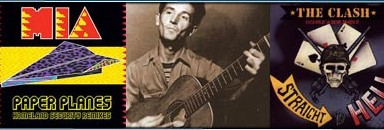
“Paper Planes,” M.I.A.’s irresistible and ubiquitous alternative hip-hop track from 2007-08 combines her riff on the lyrical threads of the Clash classic, “Straight to Hell”, as well as a sample of it, alongside her own insouciant rap style and insistent and poetic verses. Punctuated by percussive pop, pop, pops and ka-ching sounds, the songs roots roll deep—from British punk and black empowerment, to American topical protest, in the mode of Woody Guthrie. Five years later, Maya Aprulgasam’s “Paper Planes” endures as music with a pointed message, a high-tilt boogie down production taking in immigration reform, ongoing war, and economic disrepair, though at the time it was released, it was largely misunderstood. It was also a hit record, the likes of which Woody Guthrie would not enjoy or ever know in his lifetime. But safe to say, he was the first contemporary singer to take on the dignity of the immigrant as the subject of a song: In 1948, Guthrie wrote “Deportee (Plane Wreck at Los Gatos).” It is performed here by Bob Dylan and Joan Baez.
The song concerns the treatment of 28 migrant farm workers, their deportation, and accidental demise in a plane crash as they were being returned to Mexico from Central California. Guthrie was struck by the facts: The immigrants were not mentioned by name in news reports (the vitals on the American flight crew got full coverage) and they were buried in a mass, unmarked grave. He wrote the unidentified departed what started out as a poem: “Goodbye to my Juan, goodbye Rosalita, adiós mis amigos, Jesús y María.” Ten years later, schoolteacher Martin Hoffman set it to music. Popularized by Pete Seeger, it is still sung and recorded, most famously by the Byrds, Joan Baez, Billy Bragg, and Bruce Springsteen. “Deportee” remains standing not only as a eulogy, but as a statement on the lack of rights and the poor conditions faced by immigrant farm workers to this day.
The Clash, and Joe Strummer in particular, were known the world over for covering the common man’s concerns, as well as the human cost of empire-building in song. Opening her immigrant song with four bars of “Straight to Hell”, M.I.A. tells us where the song is going and what it’s about before singing a word. Among Strummer’s most celebrated lyrics, its verses are devoted to the plight of the dispossessed. Not exactly sung (perhaps inspired by his new friend, poet Allen Ginsberg, who sat in on the Combat Rock sessions), “Straight to Hell” is a song to the outsider. It signifies where she stands in so-called “polite society,” whether cast-off North of England or in Vietnam: It could be anywhere… any hemisphere… no man’s land and there ain’t no asylum here, in the words of Strummer, or as Guthrie plays it, They chased them like outlaws, like rustlers, like thieves.
Guthrie’s Some of us are illegal, and others not wanted, ring out in Strummer’s … There ain’t no need for ya. Go straight to hell, boys….. The Clashman said he wrote the song while staying at the Iroquois Hotel, a home away from home for workers on the road to rock and roll.
“‘Straight to Hell’ was one of our absolute masterpieces. But the band had to shatter after that record,” Strummer said. Success contributed to hardliners the Clash giving up the ghost, but what they lost, 25 years later, was found when London called again in the form of M.I.A.
Originally appearing on her 2007 album, Kala, “Paper Planes” pushed ahead in 2008 when it was featured in the trailer for the stoner movie, Pineapple Express, as well as in the musical montage sequence to Slumdog Millionaire (the latter film arguably introducing a portion of mass American audiences to the multi-dimensionality of India at the time of its emergence in the world economy). Downloads of “Paper Planes” soared and an uncensored video became a YouTube sensation; to date the single has sold over two million singles in the US and has topped countless best-of lists and polls, receiving more royalties and accolades than Woody Guthrie or even Joe Strummer ever saw. The artist said her song’s success surprised her; she reckoned few would ever hear it, given her indie status at the time of its recording. Though on her way to hitsville, the song took some hits and stuck in some craws; critics thought it thuggish and hard and found ways to put down the singer’s tone. And while Arulpragasam dubs it a satire, “Paper Planes” also fits the categories of protest or empowerment anthem, reclaiming racial stereotypes.
“I don’t think immigrants are that threatening to society at all,” she said. “They’re just happy they’ve survived some war somewhere.”
As for the gunshots and cash register ring: “You can either apply it on a street level and go, ‘Oh, you’re talking about somebody robbing you and saying I’m going to take your money.’ But, really, it could be a much bigger idea: Someone’s selling you guns and making money. Selling weapons and the companies that manufacture guns—that’s probably the biggest moneymaker in the world.”
“Paper Planes” is commentary; an alternative point of view of the hardship of immigrant life and reconsideration of stereotypes leveled at those arriving from the developing world. When M.I.A. was put into the position of having to explain her song, the truth emerged in the light: The majority of immigrants are hard-working people. Many recent arrivals from far off shores have second and third jobs, driving cabs, working in restaurants, supporting families at a distance, while living multi-generationally in cramped rooms. When they die, their lives often go unacknowledged, by strangers in a strange land. That the M.I.A. song was ill-perceived speaks largely to the idea that there isn’t much familiarity or empathy for the subject of immigrants in our land, in the media, or among what used to be called “the record buying public.” It may also serve as an example of how unsung people and stories can be great motivators for songs and dialogues on a theme. Certainly the Guthrie, Strummer, and M.I.A. songs share a common message, and a common form, a heart-worn song.
Guthrie, Seeger and Paul Robeson were branded communist sympathizers and put out of work when they sang songs about forgotten people from other lands. Bob Dylan sang of the injustices met by the poor and black at home, though when he famously retreated from rigorous protest music, he was criticized and lost a portion of his audience in return for his trouble. He sang “I Pity the Poor Immigrant” and people hardly noticed it among the tracks on John Wesley Harding. When Bruce Springsteen sang “Born in the U.S.A.,” the story of a discarded veteran, he was almost universally misunderstood to be singing a patriotic song. This business of protest music has been known to be a hassle and a bit tricky; and while on one hand its more potent and pointed songs often get relegated to the underground, occasionally a white-hot blast like “Born in the U.S.A.” or “Paper Planes” strikes a chord with the mainstream, which is when there’s a chance for a real public discussion about it. Further distinguishing “Paper Planes” from much of the music on the popular charts: There is something to discuss in its content.
The additional touch of a child’s chorus in M.I.A.’s song (“All I wanna do”) was a precedent set by another important artist with an anthem: James Brown’s “Say It Loud – I’m Black and I’m Proud.”
The depth of Brown’s message song catapulted him to a front seat in community leadership; M.I.A. has also become a symbol for young people of color, especially for women’s empowerment across the world, from the subcontinent, Southeast Asia and the Middle East, to Hollis Queens, and East LA. Surely that is a good thing, though there are those who have designated her work as dangerous as they did Brown’s; what these misguided souls seem not to get is that both James Brown and M.I.A. are artists. Although M.I.A. hails from London, she was raised partly in Sri Lanka and in India by activist parents associated with the fight to liberate the Tamil region of their native country. Today, she makes her home in Brooklyn. Confusing? Not if you consider that Maya Arulpragasam, the person behind the artist M.I.A. is a refugee from a war-torn country, looking for a home in this world. The spirit of Woody Guthrie is alive and well in her and in all artists who use their voices, guitars and pens to fight injustice where they see it, recording it in a song.
[post-publication, it occurred to me that there is an undeniable link binding “Paper Planes” to Althea and Donna’s 1978 UK hit, “Uptown Top Ranking,” but that’s an extrapolation that will have to wait for another occasion].
We live in undeniably restless times. Parallels can be made to the far more tumultuous 1960s, one critical difference being the lack of unifying music. The Occupy movement’s impacted pop culture but no anthems have emerged a la Bob Dylan’s “Blowin’ in the Wind,” the Staple Singers’ “Why (Am I Treated So Bad)” or Edwin Starr’s “War.”
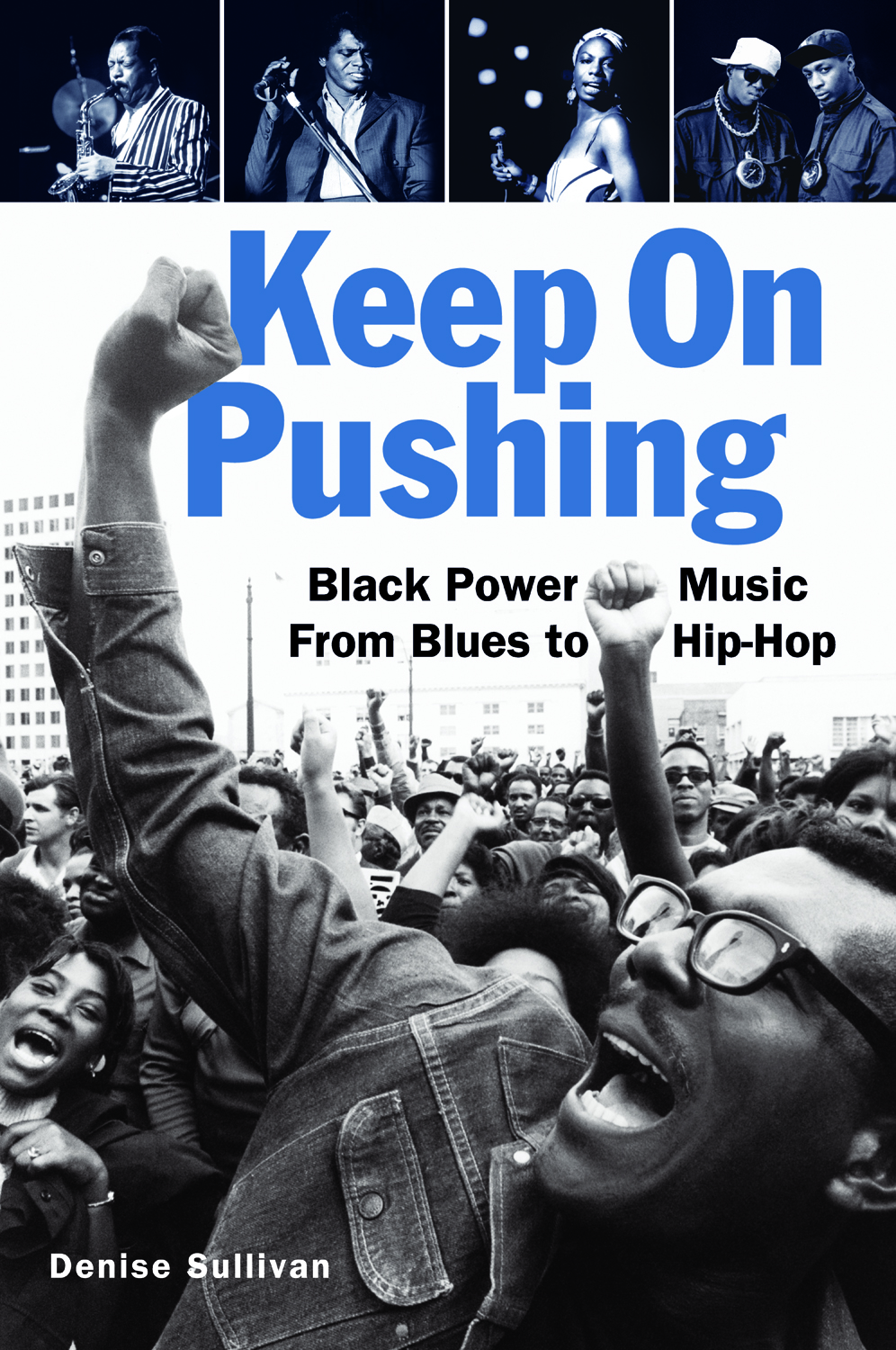
Music’s motivating role in protest movements is the focus of Denise Sullivan’s absorbing book “Keep On Pushing: Black Power Music From Blues to Hip-Hop,” from which she’ll read at Vroman’s Saturday. Five years in the making, it traces how freedom songs contributed to folk, punk and rap.
“I started by wanting to look at the music from the Black Power era, which is basically defined from about 1967 to about 1975,” Sullivan explains. “It grew into this larger survey of American resistance music, because all of that music comes out of the African-American struggle for equality and freedom.”
In following connections from blues legends (Leadbelly, Lightnin’ Hopkins) through Woodstock-era icons (Jimi Hendrix, Buffy Saint-Marie, Gil Scott-Heron) and ’70s/’80s pop stars (Marvin Gaye, Public Enemy, Bruce Springsteen) to contemporary activist/artists (Michael Franti, Tom Morello), Sullivan quotes Dave Alvin, Solomon Burke, Chuck D, Odetta, Phranc, Bobby Seale, John Trudell and Little Jerry “Swamp Dogg” Williams amidst a broad spectrum of artists.
Wayne Kramer recalls how MC5 received “intense criticism” from some who believed they should play for free. His comments feel particularly timely in light of recent controversy surrounding David Lowery’s response (http://thetrichordist.wordpress.com/2012/06/18/letter-to-emily-white-at-npr-all-songs-considered/) to an NPR intern’s essay (www.npr.org/blogs/allsongs/2012/06/16/154863819/i-never-owned-any-music-to-begin-with) asserting her peers will likely never buy music they “love.” Kramer also says MC5 wanted to make records because “it was a way to reach a lot of people.” Can music still reach and motivate large segments of the population?
Sullivan believes it potentially can, while acknowledging music doesn’t have the “currency” it had in the ’60s. She compares 1985’s star-laden, anti-apartheid single “Sun City” to recent disaster fundraisers.
“Everybody knew that song, everybody knew that video,” she says, citing “Sun City’s” MTV rotation. “We don’t have that kind of common experience. The concerts for New York City or Katrina — those were things we could experience collectively. Does it take a disaster, though, to get us all to plug into the same channel?
“A lot of artists are contributing to the Occupy effort, playing at charity efforts and all kinds of events every day. Probably now more than ever, there are musicians working at that level. Do we get a chance to hear them? Not always. You have to seek them out. It takes work.”
On Saturday, accompanied by Buddy Zapata and other musicians TBA, she hopes to create what music provides: an intimate sense of community.
“The way our lives are set up today, it seems we are less often able to gather in those kind of community spaces and have those kind of experiences. That’s how movements grew, and that’s how topical songs develop.
Denise Sullivan reads from “Keep on Pushing” at 2 p.m. Saturday at Vroman’s Bookstore, 695 E. Colorado Blvd., Pasadena. Free admission. Info: 449-5320. denisesullivan.com
As the sun sets on June and Gay Pride Month, today marks the 43rd anniversary of The Stonewall Riots. The event officially marked the beginning of the movement for gay liberation, the time when activist groups in the New Left tradition began to form a militant alliance for equal rights; one year later, the first Gay Pride parade was held on Christopher Street in New York.
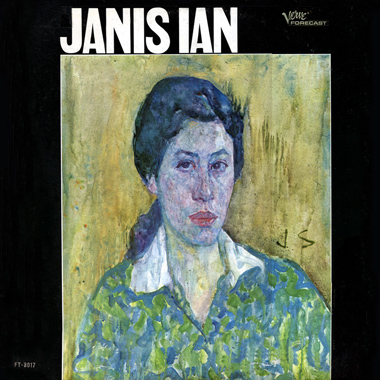
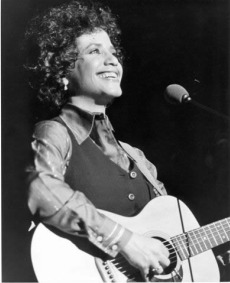
In 1969, Janis Ian did not yet identify as a lesbian, but as an 18-year-old folksinger who’d made her name at 13, inspired by the Greenwich Village folk scene, she was sensitive to the civil rights fights of her day and made a point to sing out. Her 1965 song, “Society’s Child,” concerned interracial romance at time when it was still illegal in some states; in 1967 “Society’s Child” became a hit. Forty years later, Ian was among the few people to write a song and sing about gay marriage (titled “Married in London”).
Her views on the very 21st Century issue of file sharing were also cause for controversy: As an early adapter to the Internet, in 2002, she came out strongly in favor of free downloads which was not the position the record companies were taking. (For an economic breakdown on the ways in which file sharing is harmful to recording artists, I recommend you read everything David Lowery has written on the subject, starting with this letter to a file sharing enthusiast, which went viral last week). Ian paid for her outspokenness and details the story in a series of articles and within the interview below.
Though I regret that more of my conversation with Ian didn’t make it into the manuscript of Keep on Pushing (our conversation took place while the book was in editing), I am presenting my talk with her here, largely as it appeared in Crawdaddy! Since we talked in 2010, the writer of “Society’s Child” has since turned 60; she and Pat Snyder have also celebrated 20 years of love and partnership.
“I predict that within the next two to three years everyone is going to go back to telephones,” says Janis Ian. Sound unlikely? That’s what people said when she launched a website and message board in 1992 and bet on music’s future at the dawn of the world wide web, too. Proving the skeptics wrong, Ian took more heat in 2003 when she came out in favor of file sharing, a view not generally shared by her contemporaries. And yet, as the decade closes, Ian, a self-managed artist, has found the totally wired life to be less than satisfying; though it’s great for her business, it’s not necessarily good for her art.
“This is my year of I Can’t Cope Anymore,” she says. “I don’t Twitter; I have a MySpace page that hasn’t been updated since 2008. I have a Facebook page, and I get a gazillion friend requests everyday. Why would I want to be friends with you? I don’t even know you!” Though Ian’s exasperation may sound like every boomer’s reaction to the interweb, she’s clearly no techno-phobe or old fogey; she’s simply a techie with a desire to unplug and, as an early adapter to online music and one of its biggest advocates, she’s allowed to vent. “I’ve always been interested in technology. I had a home IBM machine when they first came out. When I was 16, I did binary programming to earn extra money for awhile,” she explains. “I had been online really early—early enough that my AOL name is janisian. It was just obvious that this is where it was going. I mean, it was really obvious. It wasn’t obvious to me that we’d have iPods. I would never have dreamed about that. But it was obvious that this might be an amazing means of transportation and connection.”
“Connection” is a word that that comes up often in Ian’s story—as a songwriter, her career is based on reaching people—but plugging into a collective, connective power has been more like a mission for her. In 2002, Performing Songwriter published her piece “The Internet Debacle”, though before the article had even gone to press, Ian had royally pissed off the powers at the National Academy of Recording Arts and Sciences (NARAS), the Recording Industry Association of America (RIAA), and others in positions of influence in the music industry. “Am I concerned about losing friends, opportunities, my 10th Grammy nomination by publishing this article?” she wrote. “Yeah, I am. But sometimes things are just wrong, and when they’re that wrong they have to be addressed.” Ian took the position that free downloads were good for catalog sales, contrary to the industry’s claim that they were killing the business. And though she didn’t expect the article to be posted on over 1,000 websites and become subject of discussion from USA Today to the BBC or to create the firestorm of controversy it did, she is no stranger to friction: Her career was founded at age 13 when “Society’s Child”, her song about interracial love, was initially hated, banned, and ultimately honored as the groundbreaker it was. It is amidst a similar backdrop of high achievement, low ebbs, and complete chaos that Ian has constructed a life that has included not only music, but the study of acting and writing science fiction. In 2009, she released her recorded best on a two-disc collection of Essential Ian and told all in a book, Society’s Child: My Autobiography, now released in paperback. But make no mistake about the compiling: They’re just warm-ups for another song, another tour, and another day at the job site. As for so many workers, slowing down isn’t an option for Janis Ian.
A Virtual Life
“I was just reading a New York Times article that said Americans have now added the equivalent to a month of work hours to our work year since 1955,” says Ian. “But to be fair, almost every independent artist I know over the age of 30 is going through the same thing. The world has gotten so much more complicated and immediate; it’s sucking all our time. None of us have time to write, to play with each other… though I don’t know if it’s that different than it’s ever been. You could probably listen to Beethoven bitching about business… We’re all trying to guard our legacies, and at the same time, make a living.”
When Ian titled her 2006 album Folk Is the New Black, she wasn’t kidding: Compared to when she wrote her first song in 1963 and began to haunt Greenwich Village, there are exponentially more folksingers in the land than there are coffeehouses for them to perform in, though few of them will leave the legacy to protect that Ian will. As an exceptional product of her times, Ian played the B-3 organ into the wee hours alongside Jimi Hendrix in Village clubs, while she also had an interest taken in her by Leonard Bernstein, among other extraordinary highlights. As a teen, Ian walked with music’s giants. “[Dave] Van Ronk was great to me, always. Baez was great to me, Odetta was wonderful to me… Joplin was great to me, Hendrix was great to me, the guys in Joplin’s band were great to me… everybody except for the folk Nazis… I was pretty fortunate.” Yet none of her experiences embedded in the ’60s rock scene prepared her for the 21st century and what it had in store for her as a performing singer-songwriter.
“I’m on the same treadmill as every day-jobber I know, in that, I’m fighting to stay current and am getting further and further behind. Part of it is my choice: I would love to have a great manager, but a great manager is not going to make enough money off someone like me. I would love to have a great personal assistant, but I really can’t afford a great personal assistant. On the other hand, I’m dragging around 45 years of luggage. In this brave new world, I’m looking at five boxes of audiovisual tape that need to be transferred to digital. I’ve got two tables of CDs of myself, which I haven’t listened to, things like living room concerts and master classes. I’ve got two bags worth of slides that need to be transferred to digital, but first I have to go through them… I’ve got boxes and boxes of CDs that need to be sorted. I have two piles of CDs that people want me to listen to, and my desk is an archaeological dig. Meanwhile, I’m trying to deal with a former webmaster who went AWOL about six weeks ago and left me with nothing… this one went off with all my artwork.”
Remember, this is Janis Ian talking: Former child prodigy, writer of “Society’s Child”, “Jesse”, and “At Seventeen”, maker of over 20 albums, including one that went to number one. If things are so difficult for her, the average working songwriter is likely to be screwed. “My friend Jeannie said, ‘You know what, Janis? So you’ve got extra zeros in what you have, but you’ve got extra zeros in what you owe.’ And if you think about it, if I didn’t have hit records, I wouldn’t be paying $600 a month in storage to make sure my masters are safe. It’s all this extra stuff that comes with it that means someone like me is eventually going to start talking with places like Berklee College and saying, ‘Take this stuff off my hands and I’ll leave it to you.’” I’ve heard of the acquisition of a living artist’s ephemera by institutions of higher learning—surely there is one awaiting her call.
“I don’t even want them to buy them,” she clarifies. “I just want them to store them. It would be great to find buyers. If you find any, send them my way! It’s the same problem with instruments. I have probably 20 guitars and they’re wonderful guitars. I bought a lot of them in the early- to mid-’70s. I have a really nice vintage Les Paul. I’ve got one of the first Eddie Van Halen’s. I’ve got a Lloyd Baggs, and he doesn’t even make guitars anymore. I look at them and think, ‘If I sell all these, I could probably finish paying off the mortgage.’ So why am I looking at all these guitars that I never play? I looked at my partner yesterday and said, ‘You know, we keep working our asses off, so we won’t ever be impoverished. At what point do we get to sit back and enjoy it?’ I feel like we’ve all fallen into my parents’ trap… much as we tried not to, here we are. I’m sorry, I’m blathering on.”
No need to apologize, I tell her, I’m listening hard. As a self-employed writer married to a self-managed musician, I doubly understand Ian’s dilemma of running her self-proprietorship while keeping an eye on the future. Plus, Ian’s stories are not only relevant to self-employed writers and artists, they contain valuable information for anyone interested in this business we call music.
The Industry of Music
“We used to be in the business of music, as in busyness. We are now in the industry of music. That makes us more like US Steel, Alcoa, GE, than anything to do with the arts. I hope that it would be self-limiting, like museums are, but it’s not because of technology. So what you have are these huge, moribund institutions—what are there, three record companies now, maybe four? And they change just as slowly as any institution.” Ian suggests that it’s literally a lack of vision that prevents the changes from rolling. “If you’ve ever tried to get a streetlight put up, you know how slowly these things work. I think what’s happened is something very similar to why Columbia Records lost out on the Beatles and the Stones and the early wave of pop music: Mitch Miller was head of A&R, he detested rock ‘n’ roll and said it was pap. When my first webmaster and I first went to BMI and ASCAP, back in the early ’90s, and we said, ‘People are buying albums off of this new medium; there is going to be a way to give them sound bytes off of this new medium and you have to start negotiating right now [for payment of royalties],’ they laughed at us. They thought we were stupid. The record companies are the same. It’s only this last year that things have begun to change at all.
“It took them ’til three or four years ago to realize that domains would be a good thing to own. Remember when they were all trying to compete with Napster? The crappy websites they put up? Oh my god! Thank god for Amazon and iTunes, because those two have done more to help the music business than the record business has done. Sorry, but we’re on a pet peeve of mine!”
There is plenty of irony in Ian’s early argument for ownership and online music, and it isn’t lost on her. “Here I sit, worrying about how I pay the enormous cost of maintaining a huge website and I noticed Sony maintains Leonard Cohen’s and James Taylor’s and Paul Simon’s. They get a free ride. And that’s a huge advantage. On the other hand, you don’t own your own domain. I don’t know, maybe they have leasing deals. Knowing Paul, that’s entirely possible. Pluses and minuses,” she says. “Free downloading wasn’t hurting anyone but songwriters. Songwriters are getting screwed by free downloads.”
Nevertheless, Ian has always made music available for free on her website. You can go there right now and download her topical song about gay marriage, “Married in London.” Ian is so hot on providing music for free that record executives once suggested a boycott on her, though there has never been much love lost between her and her former labels. “Again, from personal experience: In 37 years as a recording artist, I’ve created 25-plus albums for major labels, and I’ve never once received a royalty check that didn’t show I owed them money,” she wrote. As an artist who has always made her living from touring, the exposure the web affords her has been worth the trade-off. “… When someone writes and tells me they came to my show because they’d downloaded a song and gotten curious, I am thrilled!” again, quoted from “The Internet Debacle.” Ian may be the exception to every rule, but seven years after she and others fought in its favor, the free download is an expected and accepted part of music consumption.
“I own a lot of my work, because I had very good lawyer. I don’t own the early stuff, I own 13 of my albums in North America and I own 16 worldwide. That’s the only way an artist can survive the new model, by keeping ownership and publishing. Because I was successful, I could go back and renegotiate. What I keep telling younger artists is the truth is that no one has sold a million albums or made a living only through the internet. Once that happens, the whole paradigm changes. But at this point, if you want a career that’s lucrative or powerful or has that amount of exposure, you still need a major. Certainly, if you want an international career, you still need a major. I think if the majors start behaving like responsible adults, who knows, it may work out. But greed always gets the best of everybody. It’s hard to convince young artists that 100 percent of nothing is really nothing. Half of my songs were reacquired, after I’d given up 50 to a hundred percent of the publishing. If you aren’t in a position of strength, the stuff is lost forever.”
Society’s Child Comes of Age
Ian’s first demo was recorded in 1963. Even in her earliest works, like “Hair Spun of Gold”, a kind of “It Was a Very Good Year” rendered as a folk ballad for the teenage set, she revealed an understanding of the world beyond her 12 years of age. The songs, as well as “Society’s Child (Baby I’ve Been Thinking)”, were featured on her 1967 self-titled, Shadow Morton-produced debut album. Morton was known for his involvement with the three-minute teen dramas by the Shangri-las from Queens, but Ian was a different kind of New York girl: Her parents were subjects of surveillance for their political beliefs and Ian was pressured to adapt “Society’s Child” to steer away from race matters. However, her folk roots and convictions told her not to back down. Though the song was withdrawn, two years later it became a hit, and helped secure Ian’s future as a working musician when she was featured singing it on a television special hosted by Leonard Bernstein. Ian’s teenage hit-maker status also made her the perfect fodder for the teeny bopper magazines, of which she was no fan. The more conservative New York Times didn’t write much about her and Ian didn’t like Rolling Stone’s treatment of female artists. But she fondly remembers Crawdaddy!,which she said filled the breach. “Crawdaddy! would write about you like you were a full artist and you were doing work that might survive your life,” she says. But Ian was having trouble surviving her own life: Burnt out by the demands of teen stardom, she took what would become her first in a series of breaks from the spotlight. In her autobiography, she writes of the time between “Society’s Child” and her next success, the heartbreak song “Jesse”, as a time when she felt as if something was terribly wrong with her. Accidentally discovering the poetry of Arthur Rimbaud, she found in his lines the freedom to devote herself to being an artist instead of pop stardom.
My eternal soul
Redeem your promise
In spite of the night alone
And the day on fire.
“I’d finally connected,” she writes. “Someone else felt like I did. Someone else had been an outsider, had tried to fit in, and had failed. Someone else gave words to my feelings, made me aware that out of such torment could come great art. And what a concept, that the artist must remake himself daily, and redefine himself in every waking moment! What a notion, that words had colors, feelings of their own!” And so it was Ian who remade herself for the first time. She broke back into the business at the time of a new women’s singer-songwriter’s movement, the outgrowth of the larger women’s liberation cause. Her song “At Seventeen” revealed the experience of teen alienation from a woman’s point of view and earned her a Grammy and a number one album in 1975. But there are days when Ian feels remorse about her greatest hit. “I hate to think that ‘At Seventeen’ is any part of that whole bleeding-all-over-yourself school of songwriting, writing from the internal rather than the external, that really started with the whole Joni Mitchell thing and hit a heyday in the ’70s and came right back at us after disco. At the end of the day, all of our lives are so boring compared to the grand scheme of things.” I suggest that “At Seventeen” still strikes a universal chord of outsider experience. “I would hope so, that would be great. That’s certainly how I approached it. But in my occasional ‘My god, what have I created?’ moments, I don’t think so.” She continued to write while her songs were getting cut by major artists, but after a good run and dogged by personal and health problems, by the mid-’80s, Ian was ready to retreat again. “My career was pretty much over in 1986,” she says. She used the time-out to study acting with the Stanislavski Method teacher, Stella Adler. “She gave me a language for what I only felt in my heart,” Ian wrote in her autobiography. “She set me free, telling me it was not only good to be an artist, it was noble.”
Returning to recorded music again in the early ’90s with her album Breaking Silence,she used the moment to come out as a lesbian, convinced that if sharing her experience could help someone, her pain would be redeemed (today she lives in Nashville with Pat Snyder, her partner of nearly 20 years). The comeback had her juggling positive press attention and live dates, but once again, she was on the recording and touring treadmill. “I had something of a resurgence… but it got really old really fast.”
Having risen to the challenge of re-establishing herself as a musician in a fickle business, Ian then proceeded to reinvent herself as a science-fiction author and as a columnist (her sci-fi short stories have been published in various anthologies and her work as a columnist for Performing Songwriterand The Advocate is archived at her website). She continues to devote more time to prose writing and a couple of years ago took a year off to write her autobiography; she found that she liked the stay-at-home writer’s life, way more than the road. “For the first time in a decade and a half, I actually had spare time. I reaffirmed some friendships and I made a new friend, which for me is a lot; I don’t make friends quickly. And I went to the clubs a bunch and re-familiarized myself with a lot of songwriters and singers, got to listen to music, I took some trips… I went to Virginia to hear bluegrass. I actually had a daily life. And then I looked at the economy, because I was thinking of trying to build my world around a life like that, and I thought, ‘I can’t afford this.’ So it’s back on the road. In some ways, that’s my day gig. Why should I be any different from anyone else with a day job? At least my day job is something I love doing.”
But she’s back on the road with a difference: Ian’s full rig, the outboard gear, the bank of pedals, and the guitar hero solos have been traded in for an acoustic. The only augmentation to her set comes in the form of stories, something she learned to tell while on her book tour. “The first time I tried to read from the book it was just horrible. So I apologized and put the book down and started telling the chapter as I remembered it. For me, the stories have become like the songs. They have their own rhythm and their own beat.” And if the book is any indication, they’re juicy too, though they are ultimately the stories of a woman in search of making a connection, with her muse, herself, and her people, the fans with whom she connected through the message board she built up in 1993.
“When my book came out last summer… they rented a bus and went all over the United States with me. If you do it right, it becomes a community,” she says. “I’ve been very clear from the beginning… I didn’t intend to make money off of that part, that I considered me paying for it part of the cost of doing business.”
Ian has also returned to songs of societal concern: “Married in London” tells of a marriage recognized everywhere but at home. “I normally don’t get up on a soapbox about things, but I was really furious. First I had to watch the Reagan years and the Bush years co-opt my country and turn it into a place that is not the place my grandparents wanted to come to, and then I was watching as my country turned its back on me and those like me, on every level—politically, socially, economically—and I was watching these people say to me, ‘All right, never mind the wedding ceremony.’ They were saying to me, ‘You can’t inherit social security. You can’t leave your partner everything.’ To me, as a songwriter, the copyright act now has reversions built in; well, those reversions can only go to your wife or husband, they can’t go to your spouse. So I can’t leave any of that to Pat. She has no standing. I couldn’t even leave it to her children. I was furious. My tour manager at the time said, ‘You need to move away from this; you need to put this in a song.’ I was writing a song that was really angry and then about halfway through I looked at it and said, ‘This is terrible… no wonder people don’t write angry songs anymore.’ It’s so rare to hear anything on the level of ‘I Ain’t Marchin’ Anymore.’ I thought, ‘I need to laugh at this,’ and so I started to write it, and it was funny. And then I thought, ‘How do I explain it to a straight audience without scaring them?’ Because that’s the trick with something like the gay rights issue. How do you present it without excluding anyone?”
There are a few more changes to the new Janis Ian: “Edging toward 60, letting my hair go white, getting rid of my lenses, wearing glasses on stage, which was always anathema, weighing more than I want to weigh… It’s all a part of saying, ‘You know what? I’m going to be 60 in a few years and this is not the same person, even if I sing the same songs a lot of the time.’” She has accepted her status among music’s elders. “You know, with Odettta’s death, between her and Van Ronk, I think it really came home for me, how limited these people older than me are. I mean, there’s Pete [Seeger], of course, who will apparently endure forever, and there’s Joan… Judy Collins, Joni Mitchell… Dylan, a lot of lost people like Ochs, Janis Joplin, those folks. And then there’s me, who’s kind of between the Baez/Collins’ and the Ani DiFrancos. I suddenly realized at Falcon Ridge [folk festival], I was being looked up to by the younger artists, as somebody to learn from and as a mentor… it’s really a weird feeling.”
Despite the usual complaints, Ian assures me there is an upside to the inevitable decline. “One of the cool things that you might look forward to about getting older, that I really learned from my book, is there is no shame in looking back. When I was younger, that seemed really embarrassing, but as you get older, you look back and you suddenly realize how many things you thought were so important were so meaningless and how many things you thought were not important are really a big deal.” Like? “Writing an article for Performing Songwriter about internet downloading would assume such huge proportions. It does kind of act as a leveler in your own head and your heart. It’s like being able to look back and go, ‘Pat and I are 20 years this year.’ That’s a leveler. I would never have thought that would happen. I think at the half-century mark we become conscious that, at its best, half our life is gone. But whether there is a way to start stripping away from my business, and stripping away at other things, and figure out what I’m going to give up in return for gaining some time, I haven’t figured it out yet.”
Perhaps when the telephone makes its comeback in a couple of years, as Ian predicts it will, we’ll give her a ring and find out how things turned out.
June is African American Music Appreciation Month, so in the spirit of appreciating, here’s a reprint of my June 2008 interview with Solomon Burke, the Philadelphia-born King of Rock’n’Soul. At the time we spoke, it was my aim to get him to talk about the soul music of the ’60s, how it soundtracked through the civil rights and black power eras to become inextricable from those times. Yet aside from his reminiscences about those times and the friends he’d lost, Burke had some other thoughts on the subject of soul that were quite unexpected. As an interviewer, I’m always happy to be surprised, but what I really didn’t expect was how four years later, I would still be carrying the conversation with me. Nor did I realize till much later, the ways in which our talk would ultimately set the course I took for my book, Keep on Pushing (this is mostly a full transcript of the first interview, including some parts that didn’t appear in the book). Burke’s final recording, Nothing’s Impossible, made with Willie Mitchell at Royal Recorders in Memphis and released in 2010, was a fine farewell. The singer passed on October 10, 2010, on his way to Amsterdam where he was quite popular. I regret I never got the chance to say thanks again for the inspiration he provided me over the course of our two interviews.
“Liberace was soulful. In fact, you couldn’t get any more soulful than Liberace,” laughs Solomon Burke, only he’s not joking.
Ever since 1964, when an enthusiastic DJ crowned Burke the King of Rock ‘n’ Soul, he’s taken his title seriously. Plus his added credential as a minister born into the House of God of All People means when you ask him a question like, “What is soul?,” he’s going to go deep.
“Kennedy was soulful. Him and Robert together were two soulful brothers, doing their thing, you know, releasing their energies. They could say a few words and boom, you felt it. It made a difference.”
Not too long into my conversation with Mr. Burke, as I was happy to address him (and he didn’t discourage me), boom, I felt it too. Whether it’s his clerical background or just part of his nature to be a listener, Burke is a skilled raconteur who saves space for other voices in the room, responding on a careful soul to soul basis with his conversant. For example, he was just as keen to talk about my work as he was his own (I’ve edited out most of that conversation for the interest of the general readership). Author Peter Guaralnick, in his book Sweet Soul Music, referred to Burke as a “…rare spirit, a ‘character who is also a serious artist’” and to his “outsized spirit and outsized talent.” Most of what I know about Burke’s history comes from Guaralnick’s interviews with him. But what I felt when I talked to Burke myself was something else entirely—perhaps best described as spiritual refreshment—and it’s something that I will carry with me from here.
He’s a Philadelphia native who loves country music and a former “wonderboy preacher,” with 21 children, 89 grandchildren, and 20 great grandchildren. “I’m blessed to have children and grandchildren in almost every state… they’re my record promotion staff!” As a full-time singer, he’s managed to oversee a fleet of snowplows, run concert hall concessions, a drugstore, and tend to corpses as a doctor of mortuary science (no, not all at the same time, but usually by juggling more than one extra-musical activity at a time). As an earthbound man of large appetites and unstoppable force, his road has been paved with many contradictions. His peers called him one of the greats—he’s counted Sam Cooke and Otis Redding among his close friends—though he lost them when they died young and under unsettling circumstances. “If You Need Me” (written by his friend Wilson Pickett), “You Can Make It if You Try”, and “I Wish I Knew (How It Would Feel to Be Free)” are foundational to soul sound, style, and attitude, though Burke’s renditions never moved into the mainstream from their R&B chart positions. Jerry Wexler who signed Burke to Atlantic called him the greatest soul singer of all time, yet when Burke sought Wexler’s help in building community-based businesses and charities with profits from the Soul Clan (Don Covay, Ben E. King, Arthur Conley, and Joe Tex), he was told, “Go back and learn some more songs and pay attention to your records and get out there on that road and try to promote these records and stop thinking on that other stuff,” says Burke. “He didn’t want us to be entrepreneurs; he wanted us to be record sellers.”
So that’s what he did, leaving Atlantic behind for smaller concerns like Bell and Chess, though there were times he fell off the record radar and into “the pits of hell,” as he calls the hard times. Burke may have lost some fortune, but he never lost his humanity nor his versatile, velvet vocal hammer quality; it’s a combination that appealed to fans like the Rolling Stones, who covered him back in the day, and Elvis Costello, Van Morrison, and Tom Waits, who submitted songs to be covered by him on his 2004, award-winning return to rock ‘n’ soul, Don’t Give Up on Me. He’s since released a tribute to country titled Nashville, and a collection featuring gospel greats is in the works. In June 2008, he delivered Like a Fire with its title song written for Burke by his friend Eric Clapton. The smoldering blues, pop, and twang album includes “We Don’t Need It”, an old school-styled soul song written by Keb’ Mo, and the tough “A Minute to Rest and a Second to Pray”, by Ben Harper, who sits in on the track. The sessions for Like a Fire were overseen by Steve Jordan, a producer and drummer for rock’s super-names who also wrote and co-wrote some songs. When Crawdaddy! contacted Burke for this interview, he was at home in Southern California, where he’s lived for 40 years. Following an 18-week stand at the Sands in Vegas and an offer to do 12 more, he went to LA for a little vacation. “I called my mother in Philadelphia, said I was bored here with nothing to do, and she said, ‘Don’t come home now, there’s six feet of snow.’ So I thought, I’ll take a little vacation. I’ve been on vacation ever since 1968!”
Crawdaddy!: I want to start by saying thanks for all the great music.
Solomon Burke: I’m still trying.
Crawdaddy!: You’re succeeding. Your performances on the new album are as moving as ever. Tell me how you first became acquainted with Steve Jordan.
Burke: We’d been talking about making an album for a couple of years now… I worked with him on festivals and I loved his rhythms. It’s so nice when you’re working on a big festival show with 75 acts and you only have 20 minutes to rehearse and the drummer’s on time, someone who keeps the rhythm and the pulse. He’s not only a taskmaster—I recognized him as a great musician and a beautiful person.
Crawdaddy!: When you got the songs together for this one, was he a part of the selection process?
Burke: He was certainly a part of that—we had a wealth of songs to choose from. We had these songs from my great friend Eric Clapton, “Like a Fire” and “Thank You”, and I wanted to go with the strongest songs that would make the strongest story, because the story has to be able to reach somebody. That’s my goal.
Crawdaddy!: What piece of Clapton’s song “Like a Fire” jumped out and made you recognize, “This is the story”?
Burke: I had quite a few of those on this CD but it was the line, “burning in my soul.” There’s a difference from when it’s burning in your heart or burning in your mind. When it’s burning in your soul it’s affecting the movement, your expression, your taste, your desires, your needs. It’s deep—it’s deeper than heartache—it’s burning in your soul. A lot of people don’t understand that and this is why, to me, it meant so much. It was able to get to the core of the feeling and I just wanted to sing it lightly, and as rightly as possible, without shouting it and without hammering it and without bam bam bamming it out, but with that touch. And he has that magic touch on the guitar that’s so comforting.
Crawdaddy!: Yes, that is the exact description of it—comforting. I want to come back to the songs but since the subject of soul’s come up, it would be great if the King of Rock ‘n’ Soul would define soul in his own words.
Burke: You set me right up for this one: It’s a burning desire, that’s an everlasting fire, burning inside the heart and mind and spirit that develops a soul. It happens with you in your writing, it happens to a cook, to a poet, and an artist. When something happens that you create and develop, it’s a personal soul expression that comes out. You and I may talk for an hour and you may take 10 minutes of what I said and make it all come out in 10 lines or 10 words. That’s the soulful expression coming from you, connecting with me, or whomever you’re dealing with. That’s the song, that burning desire, that’s like a fire within us. We either turn the flame up or turn it down. We make it work for us. The soul within you regulates exactly what you need and what you want and what you desire to release.
Crawdaddy!: How about the phenomenon of soul music and its rise in the ’60s? Will you speak to that aspect of soul and how it relates to the African American experience?
Burke: Well, it’s very nice to think that it’s a category of race but it’s not—it’s a category of face. It’s face value: Who you are, what you value, and what you’re about. It makes no difference what color your skin is or what country you’re from. It has nothing to do with color, it has nothing to do with time, it has nothing to do with a certain world. It’s who you are. Tom Jones is soulful. Dusty Springfield is soulful. We can go back… Beethoven was soulful. Marian Anderson was soulful. Paul Robeson was soulful. Liberace was soulful. You couldn’t get anymore soulful than Liberace! Ray Charles… c’mon!
Crawdaddy!: What do you think shuts down the soul and extinguishes the fire?
Burke: All of it: Lack of love, lack of affection, confusion… all these things contribute to that lack of soul.
Crawdaddy!: When I think of the great soul singers I can’t help but think of their personal trials…
Burke: Sam Cooke. Jackie Wilson. C’mon! Wilson Pickett… you know, Aretha Franklin… there’s a fire burning inside of her right now, right this minute. If we could get a hold of her right now, you could hear that fire. When she sings certain songs, it’s released. When she sings, “Chain chain chain,” you can hear a thousand people singing it. That was written by Don Covay, who can express it better than anyone in the world, but he wrote it for Aretha because he felt her need. Tom Jones sang, “What’s new pussycat?” I could say it 40 times and it doesn’t come out like he does. When I say it, it sounds like I’m talking about a cat! When he says it, it’s a love affair. Isn’t that amazing?
Crawdaddy!: I really like that idea of a soul connection, as you say, Don Covay could really feel that Aretha needed to sing that song and passed it on.
Burke: Right. And he wrote it saying nobody can sing this but her. Imagine being the creator of this song—he’s such a great writer—I wrote many songs with him—”Goodbye Baby (Baby Goodbye)”, “Tonight’s the Night”, he wrote “Chain, Chain, Chain” [“Chain of Fools”]. When I got the song “Don’t Give Up on Me”…
Crawdaddy!: The Keb’ Mo song on your album? That’s right in that spirit, isn’t it?
Burke: Right in that spirit: “I don’t want it / I don’t need it”… that song is today. There is somebody sitting in their car saying, “My car note’s two months behind, rent’s late, and now I’ve been laid off. How am I going to go in there and tell these kids I ain’t got no money for their graduation? How am I going to deal with this? I’ve already been to the pawn shop…”
Crawdaddy!: That’s exactly what’s happening. People need music that speaks to the soul in these times!
Burke: People need each other. We need to realize that we’re all one. We need to touch upon each other’s hearts and not try to destroy each other.
Crawdaddy!: Amen. Will you talk a little about Ben Harper’s soulful nature? I see him showing up at all kinds of community events, speaking out, pitching in.
Burke: Isn’t that scary? Is his soul a message of the word or what? I turn the television on and I say, “Oh my God, tornados, floods, earthquakes, war… how much time we got? Just a minute to rest?” Can you imagine a soldier leaning against the wall saying, we got a minute… now we gotta go, and pray we get to the other side? These are the things that affect me. This is what affected me with this song [“A Minute to Rest, A Second to Pray”]. If I can bring home that message to someone and say, “Stop! Stop dealing with drugs. Give up that gang. Put that gun away. Don’t hold up that store. Don’t rob that person. You’re losing your life in one minute. You’re taking away everything you dreamed for. That’s not the answer. Don’t run away from home. Think about it. It can work out. Just take a minute.”
Crawddady!: Did you have any role models to inspire you in your ministry work as you were coming up?
Burke: I had an extra blessing because when I was born I had the support of trombones, tubas, and bass drums. I never knew what key I was crying in but I must’ve done all right because it didn’t confuse the church! So I thank God for that and I thank God for that guidance my grandmother gave me—that walks with me today and has not changed my connection or direction, and has allowed me to go through trials and tribulations and situations. Beyond a terrible moment of life and from the pits of hell, I can emerge, and I want to teach others to emerge from that. Trouble doesn’t last always. And where there’s a dark cloud, there’s a sun getting ready to shine. There is a rainbow.
Crawdaddy!: Your album Don’t Give Up on Me was perceived as a comeback. What did it mean to you?
Burke: I called it a come up. It was a step up. I was catching up to my step up… the Fat Possum situation was an incredible story. I met this fellow at a festival in Portland. He said, “I’m with Fat Possum,” and I said, man, what kind of insult is this? I mean, I’m trying to lose weight, I’m working on it! I told my daughter, don’t be evil to the guy, he’s a nice guy, but just get his number or something and we’ll call him… this tall guy with afro hair sticking out, and I’m thinking he’s gotta be some coach for the Fat Possums… he wants me to be their mascot. So I get on the plane and he’s the last person on the plane and he sits right behind me. He says, “… I don’t know if you believe in fate…” And I say, “Do I believe in fate? Do you have a suit that’ll fit me?” That’s the beginning of that story. We hit it off, had lunch, and made a record. It was one of the greatest moments in my career and the first record company that was ever sincere and dedicated and real; it has left an everlasting memory in my mind. We had a two-page contract; they lived up to every word of that contract and they did everything they possibly could for that record to bring it home and they gave me my first Grammy. But they gave me great songs—Elvis Costello, Van Morrison, come on, that was an incredible CD.
Crawdaddy!: Did they have to sell you on the producer?
Burke: They had to sell me on Joe Henry because I didn’t know Joe Henry and Joe Henry didn’t know me. But what I liked about it was there he was with us having lunch at a deli and he wanted some grilled pork chops. I’m having matzo ball soup and he wants grilled pork chops? This is the guy we need to have producing. Little coincidences that for me are the soulful part of it, that special touch of soul we talk about.
Crawdaddy!: There’s plenty to say about the technical aspects of your new record, playing, songwriting, and production, though I’m afraid we just got around to the soul of it today. I think our talk helped me more than it will help your record!
Burke: It’s not about the album, it’s about this moment in time. I tell Eric that there are a lot of people who understand what we’re doing. And he says, “I’m glad.” This is the secret: We don’t stop. Once
we’re on the move, we keep going. We don’t turn backwards. We go forward because it’s a journey, it’s not a trip. Anyone can do a trip, one way or round trip. When you’re on a journey, you have a destination.
Crawdaddy!: Speaking of journeys, I noticed your summer concert schedule: Europe in one city a day? How do you endure?
Burke: Prayer. And faith… because that’s the journey that we’re on. We’re sending out that message: Send a little love, let’s light a fire, don’t give up on me, I can’t stop loving you, If you need me call me… isn’t it amazing?
Sen. Robert F. Kennedy was preparing his bid for the presidency, looking as if he would surely be the one chosen to lead his country through the deep water. Like Dr. King, he had grown in favor of withdrawing troops from Vietnam. From his seat on Capitol Hill, he had become a fierce advocate of civil rights and economic justice and the social programs to accompany those ends, supported by a progressive belief within his faith. Following his victory in the California primary election, on June 5, 1968, he too was shot down, two months after the loss of Dr. King.
Has anybody here seen my old friend Bobby? Can you tell me where he’s gone?
So went the Dick Holler song, “Abraham, Martin and John,” it’s final verse devoted to “Bobby.” Written in response to the 1968 assassinations, it was first recorded by Dion DiMucci; Smokey Robinson, Marvin Gaye, and Harry Belafonte were also moved to record the song, as were others as time and the years wore on.
In this clip, Smokey Robinson sings and talks a bit about what the song has meant to him, during a 2010 performance at the White House.
This piece originally ran as an Origin of Song column in Crawdaddy! in the Spring of 2010. It’s time to play it again, man.
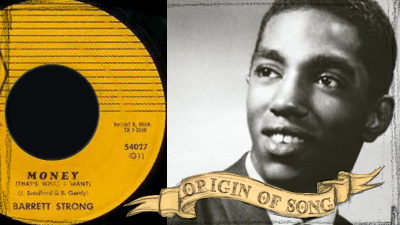
These unprecedented times of bail-outs and world economic crisis have me thinking a lot on money: Who’s got it, who doesn’t, how they got it, and how I can get my hands on some of it. Money. That’s what I want. Which is how I’ve come to consider the case of Barrett Strong.
Born February 5, 1941 in Hard Times, Mississippi, you know him as the songwriting partner of Norman Whitfield and all those right-on Motown hits: “War” (“Good God! What is it good for? Absolutely nothing”); “Smiling Faces Sometimes” (“They don’t tell the truth”); “Psychedelic Shack” (“That’s where it’s at”), “Cloud Nine,” (“I’m doing fine”); “Ball of Confusion (That’s What the World Is Today)” and “Heard it Through the Grapevine.” The guys were geniuses, Songwriting Hall of Famers and all that, but, before the string of hits, he was strong out the gate: The Beatles knew him as the guy who sang “Money (That’s What I Want).” He was the one who came up with the riff and scored the first hit record for a then-brand new little label called Tamla, and chances are you’ve heard the rest. If not, check this:
Tired of earning pennies on the dollar for writing songs for Detroit’s R&B pride, Jackie Wilson, songwriter Berry Gordy switched over to music’s business side. In competition with his sister Anna and the record label that was her namesake, he formed his own label, Tamla, his roster consisting almost entirely of kids from around the way, with a few notes from his own songbook. Distributed by Anna, by June of 1960, “Money (That’s What I Want”—written by Strong, with credit taken by Gordy and Janie Bradford and performed by Barrett Strong—was the company’s first national hit, reaching number two on the R&B charts and crossing over to the Top 40. It turned out to be as prophetic as it was strong: “Well now give me money (that’s what I want)… I wanna be free.” Not long after that, Gordy’s friend and label VP, Smokey Robinson, sold a million copies of “Shop Around” with his group the Miracles. The self-contained, family-like, black-owned business from the Motor City delivered “The Sound of Young America” to the world with its especially designed blend of pop and R&B, intended to steer the singers away from the sounds of the stratified R&B chart ghetto and into the spotlight, where American Dreams were made. Sadly, many of Motown’s own were shorted on their share of their contributions—and those details are being worked out and worked over to this very day.
Back then, people used to love the idea of made-in-America music and all that American dream stuff, especially in England, which is how the Beatles fit in: The song first showed up in their sets during their stay in Hamburg, Germany as a crash-bang encore. In the Beatles Anthology, George recalls first hearing Strong’s single in Brian Epstein’s record shop; Ringo notes they all had the same records anyway, and “Money” was likely one of them. Included on their famously rejected demo for Decca Records, it was eventually released and closed their second album, With the Beatles, alongside two more Motown songs: “Please Mr. Postman”, originally cut by the Marvellettes, and Smokey Robinson’s “You Really Got A Hold On Me” (adding up to a bonus for Mr. Gordy). Listen and you’ll hear Ringo playing just a bit heavier as the band emphasizes the riffing—which is how it got to be known as one of the original hard rock songs. Perhaps it sounds quaint these days, but just listen to how they rock it, especially in the final choruses: In comparison to their songs at the time, “Money” was nuts—and people like nuts—and it was even a bump up the nut scale from “Twist and Shout.”
More on “Money” and how it came to define the Beat sound of the early ‘60s can be discovered at this quick one stop source for Beatle stuff. Additionally, the in-your-face essence of “Money (That’s What I Want)” suited John’s image as the impatient, angry, and snotty head Beatle, and earned him a rep as the group’s rocker; it was a fact that got up “the cute one” Paul’s nose since he too was capable of ripping it up, Little Richard style, as in his performance of “Long Tall Sally.”
Meanwhile, back in Dee-troit, as he famously called it in one of his songs, John Lee Hooker came out with “I Need Some Money”, the very same Barrett Strong song, releasing it the same month that Tamla was having a national hit with it, and delivering it in John Lee mostly one-chord boogie-style.
As time went on, they were doing the “Money” dance in London (the Who and Led Zeppelin), up in Washington state (Pearl Jam and the Sonics), and don’t forget the motor city—where there was dancing in the streets to versions by Strong’s Motown labelmates the Supremes and Junior Walker and the All Stars.
In the ‘70s, it became cool to bad-rap greenbacks—something to do with the cynicism of the decade’s great recession, which was—as surely you remember or perhaps as you’ve heard—the worst since the Great Depression (ha!). In 1973, Pink Floyd went Biblical with it: (“Money is the root of all evil”) in their “Money”, with its cash register ka-ching sound effects. And oh, the sarcasm: “New car, caviar, four-star daydream, think I’ll buy me a football team.” So, too, to the Bible did go, the O’Jays (“I know that money is the root of all evil”) when they Gamble and Huff-ed their way through “For the Love of Money,” an anti-song to the “lean, mean green,” also from 1973. A couple of years later, still suffering from the post-recession-boho-blues, Patti Smith wrote about dreaming of winning lotteries and robbing banks in “Free Money.” Even Abba took the rich man to task in “Money, Money, Money.”
But by 1979, memory of the oil crisis and resulting ecological awareness that marked the ‘70s was starting to fade and money madness was coming back in style. The spirit of Gordy and Strong’s song came back in an ultra-cynical form as performed by the Flying Lizards, with a version that bridged the gap between punk rock desperation and the go-go ‘80s. Of all the renditions, it seems to be the one that enjoys the most spins today, turning up in movies and on television. The usages, as they say in the business, all generate a lot of green for Gordy. From then until now, there were plenty of money-positive songs going around, songs about material girls in the material world, and tough guys getting paid in full, making bank. I personally liked “Gimme Some Money,” Spinal Tap’s send-up of “Money (That’s What I Want).”
Sometimes I regret not boarding the gravy train, but most days I’m happy to feel like Paul McCartney did (‘til he became rich) when he supposedly wrote “Can’t Buy Me Love”, to counter the cash-grabby “Money (That’s What I Want).” But when times are hard, who doesn’t like to dream about free money? So try saying it out loud with me: “Money (That’s What I Want).” It worked for Berry Gordy and Barrett Strong, the Flying Lizards and the Beatles. Say it again: “Money (That’s What I Want).” I like to tell myself, like Swamp Dogg says, “I’m not selling out, I’m buying in.” So say it, one more time y’all: “Money (That’s What I Want).” I think I like the sound of that tune.

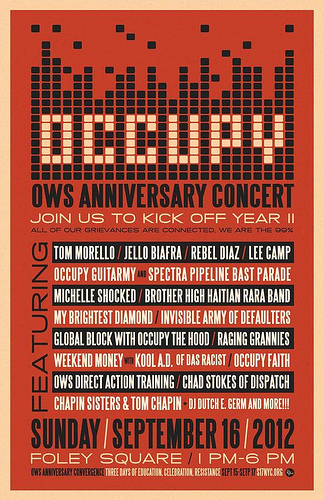 Hats off to West Coast artists Tom Morello, Jello Biafra and Michelle Shocked for joining Lee Ranaldo and Co.at New York’s Foley Square Park last Sunday for the kick off of the one year anniversary week of Occupy. Shocked performed “99 Ways to Loathe Your Lender,” sung to the tune of Paul Simon’s “50 Ways to Leave Your Lover.” Though Shocked discourages filming of her shows, I hope she won’t mind that I found a barely viewed clip of her performing it (she follows Biafra’s spoken word piece). The protest standard, “Which Side Are You On,” was performed as a singalong (it’s as close as any song the movement has to an official anthem). Happy Anniversary Occupy, and thank you to the Occupiers and musicians who represent the 99 percent.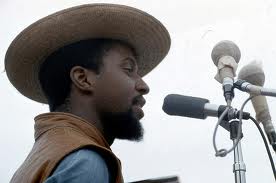
 Denise Sullivan