Cambio’s album title, I, Too, Sing America caught my eye for being named after a Langston Hughes poem(his answer to Walt Whitman’s work, “I Hear America Singing”). Cambio’s music caught my ear, too, thanks to his talk with Ignacio Palmieri on KPOO last week. With allusions to illusions, references to referendums, and tracks built on layers upon sound bites, scratch noises, and clips of speeches, Cambio’s point of view is progressive to the max, and that powerful voice is at the center of the mix.
Californian by birth, Latino by descent, Cambio is from Watsonville while belonging to Quilombo Arte, the international collective of artists, writers and musicians spearheaded by Mexico’s Bocafloja, committed to breaking down barriers and to emancipation for all people.
As a Latino influenced by hip hop, a young man in love with basketball and a speaker of “broken Spanish,” Cambio described himself as “having issues within his own community.” It was through becoming educated and learning the stories of colonization that he began to seek and find his place in the world as an artist. Beginning to record and perform locally, it was by chance that Bocafloja heard Cambio’s recordings and reached out to him. Though he records in English, Cambio has since found an audience for his music in Mexico and throughout Latin America.
An earlier album, Or Does It Explode?, also has a title borrowed from a Hughes poem (“A Dream Deferred”); a newer project, Underground Railroad, of course refers to the network built from slavery to freedom. History, poetry, social movement and music are among the themes in Cambio’s work: One minute he’ll borrow from Malcolm X, Fred Hampton or Che Guevara, the next from Nina Simone or Bob Dylan. Here’s “Eyes Wander,” featuring Favi and DJ Ethos.
There is so much to like about Cambio, so much more to learn and know, but the music speaks volumes on its own. Listen for yourself on his Bandcamp page. You may also hear the archived broadcast (scroll down) of the show I heard. I encourage you to listen and support cambio: Positive hip hop is marginalized and Cambio’s is a voice that if given a proper hearing could resound all over this land. He, too, sings America.
The following clip features the voice of Langston Hughes reading from the poem that started it all.
“Somewhere I read of the freedom of assembly. Somewhere I read of the freedom of speech. Somewhere I read of the freedom of the press. Somewhere I read that the greatness of America is the right to protest for right,” said Dr. King in his final speech, delivered on April 3 to striking sanitation workers in Memphis, Tennessee. The following day, April 4, the civil rights leader, winner of the Nobel Peace Prize, and beloved hero to millions around the world, was shot to death on the balcony of the Lorraine Motel. Forty-five years later, the work of non-violent protest in the name of desegregation, voting rights, racial harmony, jobs, freedom, opportunity, and an end to wars, is carried on by an international community of civil rights advocates and human rights and anti-war activists. Among the musical tributes in response to the tragedy were Dion’s popular “Abraham, Martin and John,” Otis Spann’s less-known “Blues for Martin Luther King, ” and Nina Simone’s enduring and emotional “Why (The King of Love is Dead),” first performed in his memory on April 7, 1968, the national day of mourning following the assassination. For further reflection on Dr. King’s message of love, please start with the The King Center archives, dedicated to the non-violent eradication of poverty, racism and violence.
April marks National Poetry Month and Jazz Appreciation Month. This month’s posts will attempt to shine a light on great moments and people in jazz and poetry history, as well as the places where the two forms meet.
In 1970, Gil Scott-Heron was barely 21 when his first novel, The Vulture, was published and his startling, spoken-word record, Small Talk at 125th and Lenox, caught his incisive cool on tape. “I consider myself neither poet, composer, or musician. These are merely tools used by sensitive men to carve out a piece of beauty or truth that they hope may lead to peace and salvation,” he wrote in the album’s liner notes. Accompanied only by conga drums and percussion, Small Talk at 125th and Lenox featured a reading of “The Revolution Will Not Be Televised”, Scott-Heron’s most enduring work and an early masterpiece, its flow combining elements of both poetry and jazz.
“The revolution will not be brought to you by Xerox
In four parts without commercial interruptions.”
Excoriating the media and marketing, the song’s structure burrowed its way into the collective consciousness of musicians—both mainstream and underground—and listeners alike; it is referenced throughout music, and rather un-ironically the title phrase has been repurposed to advertise consumer goods, from sneakers to television itself. The piece is also, of course, foundational to hip-hop, its words potent and direct, even if some of the allusions and references may be lost on those uneducated in ‘60s or ‘70s culture. It also sounds great, which explains why it’s a standard-bearer for all music, whether it be politicized rock’n’soul, funk or jazz. Pulsing throughout the piece is Scott-Heron’s projection, a foreshadowing of the realities of global connectivity and the pacifying effect on the brain produced by viewing from a small screen. Heron’s vision was a word to the wise:
“The revolution will not give your mouth sex appeal…
The revolution will not make you look five pounds
thinner, because the revolution will not be televised.”
Positing a necessary parsing of media-generated “reality” from truth and setting his poem to music on his 1971 album, Pieces of a Man, Scott-Heron was caught in the chasm between jazz and soul, poetry and rock, and few knew just what to do with the new poet and big bass voice on the scene, though time would reveal his impact: As the years rolled by, this poet of vision would weigh in on matters environmental and racial, as well as political and social. Though Scott-Heron’s voice was too often a cry in wilderness, it served as a clarion for future generations of conscious writers and thinkers.
Scott-Heron was raised in Tennessee by his grandmother, until he and his single mother, a librarian, eventually moved north to New York City. As a teenager, he excelled at writing and earned enrollment at Fieldston, a progressive Ivy League preparatory school. Upon graduation, he chose to attend Lincoln University in Philadelphia, quite simply because it was the alma mater of poet Langston Hughes. As a musician, Scott-Heron’s style was conjoined with the word styles of Hughes, as well as those of talkers like Malcolm X and Huey Newton. But it was “musicians more than writers” who inspired him, and he used the rhythms of folk, blues, soul, and jazz to fulfill the intensity of his emotion. “Richie Havens—what he does with the images and themes, Coltrane—the time defiant nature and thrust of his work. Otis Redding—the way he sings lyrics so that they come through as sounds. You can really appreciate how close a saxophone is to the human voice when you hear Otis singing. I sometimes write poetry, in a way, like Otis sings. The sounds form shapes. Like clouds banging into each other. That’s how I get loud sounds in my poetry,” said Scott-Heron to Jazz and Pop‘s Nat Hentoff.
In 1969, Norman Greenbaum had a worldwide hit and US number three with “Spirit in the Sky.” Greenbaum sold over two millions copies of the single in which he claimed he had a “friend in Jesus,” never mind that he was Jewish. “Spirit in the Sky” was not the first or the last time Jesus hit the charts, but its success marked the unofficial beginning of a Jesus movement in and outside of rock that impacted the popular arts, from Broadway to Bob Dylan, in the ‘70s.
Partly a reaction to the hippie culture and also a part of it, the Jesus people, or Jesus freaks, as they were proudly known within their movement, generally sought to return Christianity to its origins. The seeds of today’s Christian right as well as its progressive left-wing were both sown in the loosely established communities/communes, and in some cases cults, which sought to throw off religious strictures as well as its staid music. Ironically, the so-called devil’s music conservatives railed against in the beginning is massively marketed today as Contemporary Christian Music (CCM), a major tool to keep young people interested in faith, but that isn’t the subject of this post. Rather, for Good Friday and Easter Weekend, I give you songs sung by generally secular rockers who went sacred at the height of the Jesus music movement of the ’70s, a 10-year period bookended by “Spirit in the Sky” and “Gotta Serve Somebody” (the last time Dylan had a hit single—#24 in 1979).
In 1966, John Lennon joked the Beatles were bigger than Jesus and caught hell for it, though by the time he invoked Christ’s name and sang of his own crucifixion in 1969’s “The Ballad of John and Yoko”, all was forgiven and only a few outlets banned it as sacrilegious. By the end of the year, the Beatles were all but said and done, and it was the Quiet One who revealed himself to be the spiritual seeker of the group. Sporting a look that was rather Christ-like, George Harrison spent four weeks at number one in the US and five weeks at number one in the UK at the end of 1970 and the beginning of 1971 with “My Sweet Lord,” the song that kicked off a kind of Jesus-mania in ’70s rock.
Speaking to his Krishna consciousness, while throwing in a couple of hallelujahs, Harrison was famously accused of copping the “doo-lang” backgrounds from the Chiffons’ “He’s So Fine” (a song about a boy which has been known to double as a spiritual). And yet, Harrison disavowed the influence, claiming his inspiration came from “Oh Happy Day”, a top five 1969 hit for the Edwin Hawkins Singers. “Oh Happy Day” grew from a Northern California gospel choir’s homemade record derived from an English hymn dating back to the 18th Century (Spiritualized revived “Oh Happy Day” in the late 20th Century). Gospel music had been rockin’ souls since at least the 18th century in the Americas, where African rhythms joined field, work, and folk songs alongside hymns from the British Isles—making way for a form of expression that gave voice to the inner lives of the oppressed. In his book People Get Ready! A New History of Black Gospel Music, author Robert Darden speaks to theological ideas and arguments toward fighting what he characterized as demonic institutions like slavery and Jim Crow law by evoking a more powerful spirit.
Here’s an example of how a song traveled in the Year of Our Lord, 1971, a big one for Jesus’ greatest hits: In May, Gene MacLellan’s song “Put Your Hand in the Hand”, the title song from the debut album by Canadian rock group Ocean, became a million-seller and high-charting Billboard hit (I’ve seen it listed as a number two as well as a three). The song was originally cut by “Snowbird” Anne Murray and went on to be recorded by Jesus-loving artists from Elvis Presley to Loretta Lynn. “Put Your Hand in the Hand” itself hearkens back to the first gospel song to score a number one crossover hit: “He’s Got the Whole World in His Hands”, as done by Laurie London in 1958. Mahalia Jackson would also put the song in Billboard’s Top 100. Jackson was of course gospel’s reigning queen throughout the civil rights era, until the Queen of Soul, Aretha Franklin, essentially dethroned her. The story of how Aretha, Sam Cooke, Curtis Mayfield, and other church singers turned gospel into soul is among the greatest told tales in music history as are the stories of the blues, a music where heaven and hell and Jesus and the devil go head to head regularly. Rock ‘n’ soul were built on gospel and blues foundation and remain inextricably intertwined, their resonances in rock proving to be everlasting (I write about gospel, blues and soul more extensively on this site and in my book, Keep on Pushing).
The Jesus rock of Ocean did not turn out to be quite as enduring, though the Jesus music movement continued to gain momentum in the ’70s thanks to, well, Jesus and the 1970 Andrew Lloyd Weber and Tim Rice album project turned hit Broadway play bearing his name. In May of 1971, songs from Jesus Christ Superstar with Ian Gillan (Deep Purple) in the role of Jesus were also making their way to the charts. Murray Head (as Judas) and his version of “Superstar” were sitting at number 20 and peaked at #14 in the US in June. Another song from the show, “I Don’t Know How to Love Him”, the him being Jesus, and the I being Mary Magdalene (as sung by Yvonne Elliman) rose to #28, also in 1971.
Even the Rolling Stones got into the Jesus spirit that year: After the darkness that marked Altamont, they traded “Sympathy for the Devil” for “when the Lord gets ready” and “You Got To Move” by Mississippi Fred McDowell (on Sticky Fingers). Here’s a clip of them in 1975 performing it with Ollie Brown and Billy Preston joining in on vocals.
In 1972, the gospel-based Staple Singers busted the crossover charts with Be Altitude, featuring the hits, “I’ll Take You There”, “Respect Yourself”, and the lesser-known “Who Do You Think You Are (Jesus Christ the Superstar)?”
In 1972, the Off-Broadway play, Godspell, scored a hit off its original cast album with “Day By Day” which went to #13 on the pop charts. Following the West End success of Jesus Christ Superstar in 1973 it was turned into a hit film, directed by Norman Jewison. Here’s a clip of Carl Anderson in the role of Judas, rockin’ the Jehovah out of the title song, followed by Murray’s Head’s chart hit version.
Curiously, it’s another Norman—not Jewison nor Greenbaum but Larry—who is widely considered to be the godfather of the aforementioned Christian rock. Bob Dylan followed his work, and Black Francis grew up on it. A bit of a wild card, Larry Norman is generally well-regarded as an artist, remembered as a risk-taker, an experimentalist, and an iconoclast who didn’t cotton to the status quo in rock or Christian music. Also contributing to the coalescence of contemporary Christian music was Explo ’72, a festival concert that gathered over 75,000 young Jesus people in Dallas to see Johnny Cash, Kris Kristofferson, Larry Norman, and gospel artist Andrae Crouch for a kind of “religious Woodstock,” so-called by the Reverend Billy Graham, who was in attendance. According to author Andrew Beaujon’s book Body Piercing Saved My Life: Inside the Phenomenon of Christian Rock, Explo set in motion the beginnings of the contemporary Christian music industry. Soon after, specialty labels formed, and the contemporary Christian music market was born to boom. “Why Should the Devil Have All the Good Music” was Norman’s answer to conservatives, who thought rockin’ for Jesus was not in concordance with the road to salvation. Though surely as the Jesus rockers were dismissed from the inner sanctum of evangelical Christiandom, they had also impacted the sound of church hymns too: Catholic mass went “folk” in the ’70s and some of those freshly arranged hymns remain in church repertoire today.
In 1972, Rhodes Scholar Kris Kristofferson sang “Jesus Was a Capricorn” on the album of the same title. He didn’t stay a Jesus rocker for long, though he had a definite claim in Jesus, given he was named for him—twice. “Morning Has Broken”, a Top 10 Cat Stevens hit in 1972, was based on the Gaelic hymn “Bunnesan” that’s been sung in churches as “Morning Has Broken” since at least 1930s. The Englishman of Greek origin has long since converted to Islam, first as a non-singer, now singing again. “Jesus is Just Alright” as covered by the Doobie Brothers was also a chart hit in 1972, though the Byrds had already recorded the Art Reynolds song in 1969.
Though by far, the biggest news in Jesus rock of the ’70s was Bob Dylan’s conversion to Christianity. Before developing his own distinct song style in the mid-‘60s, his lyrics vigorously opposed to injustice, Dylan had started out his career adapting old spirituals for his own form of protest song. By the mid-‘70s his Rolling Thunder Revue was as devoted to seeking justice for falsely accused prisoner Ruben “Hurricane” Carter as it was to the freewheeling rock ‘n’ roll lifestyle. Following that harrowing passage, Dylan, in characteristic retreat mode, embraced Christianity. Born again, he cut two gospel albums, 1979’s Slow Train Coming and Saved (1980) produced by self-proclaimed Jewish atheist Jerry Wexler. “Gotta Serve Somebody” from Slow Train Coming won the Best Male Rock Vocal Grammy and has since been covered by gospel artist Shirley Caesar,
blueswoman Etta James, Neville brother Aaron, Texas troubadour Willie Nelson, marvelous Mavis Staples, and Hammond B-3 giant Booker T. with the M.G.’s. while John Lennon (“Serve Yourself”), and Devo (undercover as a Christian rock act, Dove) famously parodied it. At the time of recording, Dylan was pilloried: His 14-night stand at San Francisco’s Warfield Theater in 1979 featured nightly picketers stationed outside the theater. The reviews were radically divided. On 1981’s Shot of Love, Dylan answered some of his critics on songs which mixed secular and sacred and yielded at least one of his most enduring spiritual works, “Every Grain of Sand.”
In part owed to the controversy inspired by Bob Dylan’s gospel period, some believers choose to keep distinctly sacred references to Jesus out of their songs while others use his name as an invocation. Dylan faithful Patti Smith famously opened her rendition of “Gloria” with the line, “Jesus died for somebody’s sins but not mine”; she titled a song and an album “Easter”, while “Ghost Dance” features the holy incantation, “we shall live again.” Her friend and collaborator Robert Mapplethorpe’s Catholicism left its fingerprint on her; she continues to be inspired by poet and artist William Blake whose portraits of the divine move beyond confines of religious dogma.
Punk and alternative rock depictions of Jesus are not unheard of: Joey Ramone sang “I’m Not Jesus”, and Jesus rode beside Paul Westerberg in “Can’t Hardly Wait”, while a rather unholy trinity of bands, the Jesus and Mary Chain, the Jesus Lizard, and Jesus Jones all named themselves after the big man. Flaming Lips, Ministry, and Spacemen 3 have got their Jesus songs too; they are but a small sample of alterna-Jesus references. Indie rock has its share of artists like Pedro the Lion and Sufjan Stevens whose Jesus-inspired work stays more on the downlow, like that of U2, Bruce Cockburn, Moby, Midnight Oil, Polyphonic Spree, and Lambchop: All make allusions to JC and Christianity while enjoying success in the secular world. In rap, the Lord’s name is occasionally given a shout-out, but none took on Jesus better than Kanye West whose 2004 single, “Jesus Walks” dared to speak of the very subject we’re talking about: With the Jesus movement in rock long in decline, to sing about him was often considered the equivalent of career suicide, yet West’s success was an exception. “Jesus Walks” peaked at #11 Pop and #2 R&B, sold over half a million copies, and was certified gold.
In 2008, the gospel songs of Dylan were compiled by the music’s greatest stars on Gotta Serve Somebody. The career of gospel songstress Mavis Staples has achieved a full-blown rock revival following her contemporary albums produced by Ry Cooder and Jeff Tweedy. Southern California roots band Dead Rock West revived the Staples classic, “This May Be the Last Time” (the song the Rolling Stones borrowed for “The Last Time”), alongside works by Blind Willie Johnson and the Jesus and Mary Chain on their gospel-inspired collection Bright Morning Stars. Though the charts may never again see the high number of Jesus jams the ‘70s saw, if you’ve got the time to seek, you’ll find plenty more from where these came.
I chose to end with this clip from Gotta Serve Somebody, The Gospel Songs of Bob Dylan because it featureswriter Paul Williams, speaking to Dylan’s Christian period.
A version of this piece originally ran in my Crawdaddy! column, The Origin of Song.
Crawdaddy! founder Paul Williams, widely considered to be the creator of modern rock’n’roll criticism, has died in Encinitas, California, following a long struggle with early onset dementia, the result of traumatic brain injury sustained following a bicycling accident in 1995.
In 1966, a 17-year-old Williams wrote, edited and distributed Crawdaddy! from his dorm room at Swarthmore College. As a young man at the epicenter of ‘60s music and movement, Williams had what is now recognized as incredible access as a journalist on the scene, whether taking calls from Bob Dylan, sitting in on a studio session and riding a plane with Jim Morrison and the Doors, partying with Beach Boy Brian Wilson, or running a gubernatorial campaign for Timothy Leary.
Here’s a clip of Paul with John Lennon and Yoko Ono at the celebrated Bed-in for Peace (he’s wearing a brown shirt, back-to-the-camera, front and center).
Williams had keen powers of observation and while his intellect was sharp, it was the emotional content of music that he attempted to unravel in his writing. Over time, Williams grew Crawdaddy! into a magazine with a circulation of 25,000—about the right size to serve his niche audience of music geeks, the diehards who lived the counterculture rock ‘n’ roll lifestyle. Williams, however, turned out to be more of a back-to-the-land guy. He left the city and turned over the magazine to capable hands while he pursued other roads—like a love of literary science fiction and tracing the evolving career of Bob Dylan as a live performer. Eventually becoming executor of the Philip K. Dick estate and editing a book of Theodore Sturgeon stories, the science fiction community also mourns the loss of Williams today.
In the ‘90s, Williams revived Crawdaddy! briefly as a newsletter; compiled by hand and from the heart, much the way he started it, his close-knit and handcrafted care contributed to Crawdaddy! maintaining its cachet through the years. It was in his middle period, of attending Bob Dylan concerts that I became acquainted with Williams while I was attempting to get my own career as a music writer up and running. He encouraged me to write my first book and introduced me to my first publisher. Williams was the closest person I had as a mentor among rock writers, though how I ended up writing for the online edition of Crawdaddy! from 2007-2011 was not related to our acquaintance. By that time, Williams had sold the rights to his magazine to an entity known as Wolfgang’s Vault and they hired me as a contributor there where it was my privilege to interview a crazy-long list of rock legends who gave me access largely based on the reputation of the magazine produced by Williams. Richie Havens, Yoko Ono, Van Dyke Parks, Eddie Kramer, Janis Ian, and John Sinclair, among others, all remembered how Crawdaddy! contributed to shaping the culture of music fan journalism, and all were happy to give back what Williams had so freely given to them with his magazine and with his words.
My interactions with Williams, a couple of handfuls of times over two decades, and just twice during his extended illness, were marked by a spark of familiarity—the kind that is shared by people who live and write inside the music, among a community of friends whose own lives are intertwined with art and music, the beauty of the everyday, and the struggle to survive it. Through the years, I closely observed Williams, watching as he maintained his dignity, despite the diminishing returns encountered by his rock writing. I noticed that he refused to compromise, that he did things for love instead of money, and admired that he remained a fan while maintaining his professional status on the inside track. As it turned out, taking a path like that is no way to make a living in the rock ‘n’ roll business, but it was a great way to live a rich life, full of love and friendship, full of writing, and full of rock’n’roll.
His passing last night comes as little surprise; the grieving process for family and friends had begun some years ago when Williams could no longer care for himself and became confined to an assisted living facility not far from the home he shared with his wife, singer-songwriter Cindy Lee Berryhill, and their son, Alexander. Last weekend in New York, Williams and his life’s work was celebrated at a one-day show of his manuscripts at the Boo-Hooray Gallery, organized by the Patti Smith Group’s Lenny Kaye. The intention of the exhibit was to shine a light on the vast literary contribution Williams made to rock journalism, science fiction, and to the study of Bob Dylan’s evolution as a performing artist in the late 20th Century.
Goodbye, Paul, with love and thanks to you for all you gave to the music, to the encouragement you gave to me as a writer, and with condolences to your friends, your sons, and your devoted wife, Cindy Lee.
Here’s a link to a piece I wrote about the love shared by Berryhill and Williams and how his longterm illness impacted and ultimately inspired her music. Some of text of this remembrance was borrowed from the piece that originally appeared in Crawdaddy! online in July 2011.
“Anybody’s who’s meant to get it, gets it, and those who don’t, they never will,” says Don Letts. The filmmaker and musician is talking about the ways in which the rhythms of Africa have a habit of turning up in popular music from around the globe, most noticeably these days in the work of Vampire Weekend and Animal Collective. But Letts could just as easily be commenting on his own career as a DJ, writer, and member of the Clash posse, or as an accidental pioneer of sampling as a member of Big Audio Dynamite, the Mick Jones-led Clash sequel.
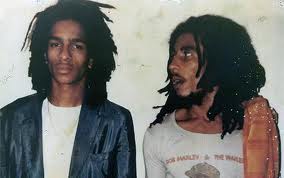
“Like a lot of great ideas, these things are stumbled upon rather than by design,” he says, somewhat understatedly. But when it comes right down to it, Letts’ life story reads like a series of 20th century music history flashpoints: From the time meeting with Bob Marley led to the Rastaman’s song “Punky Reggae Party”, to when, as a punk club DJ, he spun reggae when he ran out of punk discs (few existed at the time). “New wave/new phrase,” sang Marley. “Rejected by society / Treated with impunity / Protected by my dignity / I search for my reality / It’s a punky reggae party / And it’s all right.”
You might even say that without Letts’ point in the magic triangle, the resulting permanent alliance between the two major forms of rebel music might not have ever happened.
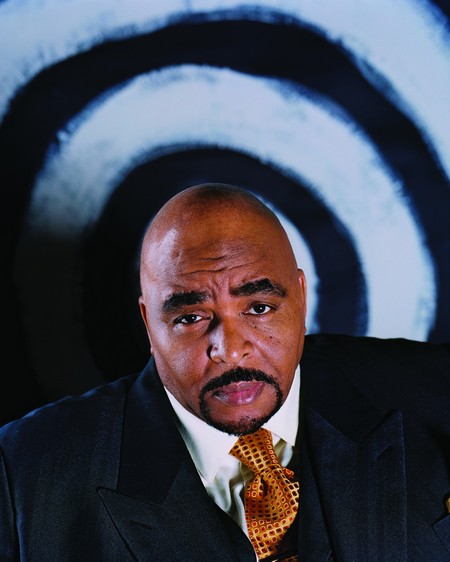
Classic Track: “Everybody Needs Somebody to Love.” Recorded by the Rolling Stones, Wilson Pickett, the 13th Floor Elevators, the North Mississippi Allstars, and even the Blues Brothers, Solomon Burke used his tune to testify his message of love until the very end (he was born on March 21, 1940 in Philadelphia and died on the morning of October 10, 2010 on his way to a sold-out gig at the world famous rock club, the Paradiso in Amsterdam). Burke first hit the Top 10 R&B charts in 1961 and 1962 with “Just Out of Reach (Of My Open Arms)” which was immediately recorded by Betty Harris, and followed with the Bert Berns song, “Cry to Me”, also cut by the Rolling Stones in 1965. That year Burke scored an R&B number one with his own song, “Got to Get You Off Of My Mind.” The decades in between the ’60s and the present have in part been described by Burke as his “pits of hell,” but by the millennium he’d made a comeback: Don’t Give Up On Me was a 2002 Grammy-winning blues album featuring songs by Elvis Costello, Brian Wilson, Nick Lowe, Bob Dylan, Van Morrison, and Tom Waits.
Career Highs: Crowned by a DJ who called him the King of Rock ‘n’ Soul in 1964, Burke took the scepter and the cape and ran with the gimmick, paying no mind to what James Brown or anyone else had to say about the title. Performing perched atop his onstage throne, Burke was inducted into the Rock and Roll Hall of Fame in 2001. He was extraordinarily honored to have performed at the Vatican for Pope John Paul II.
Career Low: He perceived that Atlantic Records honcho Jerry Wexler stonewalled his dream project, the Soul Clan, a super-group projected to make bank and fund much-needed community-based projects in the late ’60s. Initially conceived to include Otis Redding and Wilson Pickett, Redding’s death by plane crash was the first devastation. Pickett’s exit followed, which left Burke, Don Covay, Ben E. King, Arthur Conley, and Joe Tex to record a rousing single, “Soul Meeting”/”That’s How I Feel.” But when the recording budget was withdrawn, the album was filled-out with substandard tracks. “Those dreams got crushed… it shattered us,” Burke told me in 2008.
Essential Listening: Burke’s swansong Nothing’s Impossible was released in 2010; it may also be considered his masterpiece: An old-school Memphis soul recorded made in collaboration with legendary producer Willie Mitchell, they recorded it at Mitchell’s Royal Recorders, home of Al Green’s and Ann Peebles’ hits, and it got the stylized, Hi Records rhythm and sound—a fitting farewell from two soul masters.
And if you like that:Nashville (2006) a nod to his love of country music, was produced by Buddy Miller and features duets with Dolly Parton, Emmylou Harris, Gillian Welch, and Patty Griffin.
Quotable: “The best soul singer of all time.” – R&B Producer Jerry Wexler
This column originally appeared in Crawdaddy! October 11, 2010
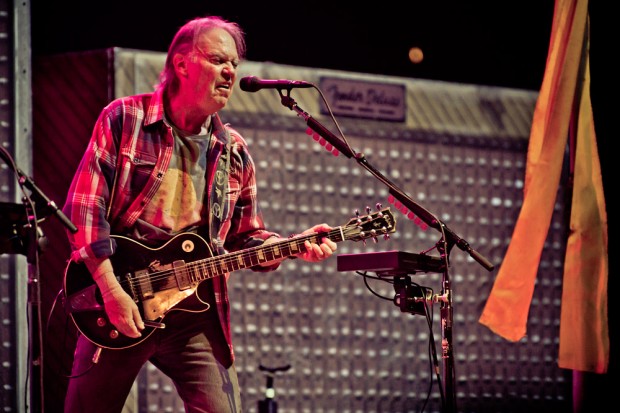
At the time the Iraq War started this month 10 years ago, millions of Americans objected to it, suspected it was unjust, and eventually came to know the truth, yet relatively few songs took on the state of the nation’s unrest or the war and its horrors. Three years into it, after the Dixie Chicks paid a very public cost for voicing their political views from the stage, Neil Young released Living With War, a concept album railing against George W. Bush and his administration.
Tuning into Jim Ladd’s show on KLOS-FM one late night in April 2006, it was by accident I heard the record’s debut, during a drive home from San Diego. I knew right then the game had changed, live on-the-air, and could hardly believe my ears: This was protest music, an album’s length of it, the likes of which wasn’t being made much anymore, at least by rock’n’roll musicians. Perhaps even more strikingly, it was direct, topical and easily understood. “Let’s impeach the president for lying,” was undeniable and couldn’t be mistaken for anything other than what it was—a protest song, and a creative blast of expression and truth. At the time, Young famously declared he was surprised that younger voices hadn’t weighed in on the subjects of war and greed, but that he could no longer wait around for someone else to do it, so he went ahead and composed and recorded the songs himself. Assisted in the studio by Rick Rosas on bass, Chad Cromwell on drums, Tommy Bray on trumpet, and the 100 voices of an LA choir, the quickly written and recorded work is an everlasting document of an artist waging peace in our time.
Young also launched a website, Living with War Today, and threw down a challenge to topical songwriters across the USA and around the world to write the songs of our lives: The best ones were posted, the songs remain, and the list is frequently updated. The site also carries reprints of relevant news items, a continuous tally of casualties, and links to sites like Iraq Veterans Against the War. Thank you to Neil Young and Co. for making Living With War and for maintaining the Living With War Today web resource: 10 years is far too long to be living with war in our hearts and our minds.
Back in the ‘80s, I’d often drive by a billboard that read, “If you lived here you’d be home by now.” I liked the sound of that, even though the sign was used to sell on-ramp-adjacent condos near a high-density traffic patch on a freeway commuter route. You have to figure the campaign was conceived by a Don Draper-styled (m)ad man (or more likely his underpaid female assistant), though whoever came up with it knew about creating the essential connection between consumer goods and comfort: It’s what we human creatures crave, and if cash can buy it, it’s hard for the body to resist. Which I guess is why I like the line, “Home is where I want to be / But I guess I’m already there,” from Talking Heads’ song, “This Must Be the Place (Naïve Melody).” It’s one of their atypically earnest love songs; the melody is simple and the groove flows in unity with the words. “This Must Be the Place (Naïve Melody)” isn’t cluttered with Talking Heads-style nervous energy or ticks; rhythmically it’s in the pocket, and the whole jam is comforting and warm—two words I generally don’t associate with their music. Best of all, this “home” isn’t asking you to buy it; you can live there as long as you like. It might just be the best song they ever made.
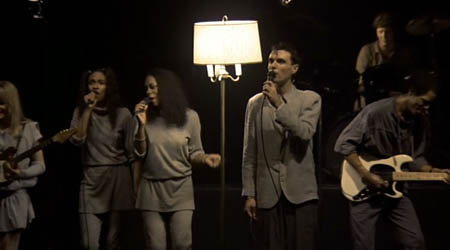
“This Must Be the Place” earned its parenthetical “naïve melody” for the way it was recorded: The band used instruments that were otherwise not assigned to them. Tina Weymouth traded her bass for Jerry Harrison’s guitar, who in turn cradled the bass; David Byrne plays the keyboards. Special guest Wally Badarou sits in on keys, and downtown performance artist/percussionist David Van Tiegham bangs on bottles and other items. Placed as the last track on Speaking in Tongues, the album would become the band’s first million seller, and might’ve been overlooked were it not released as a single following “Burning Down the House.” It was further enshrined in the band’s mythology when they performed it on the Stop Making Sense tour. Preserved on film by director Jonathan Demme the Stop Making Sense performances (widely considered to be a masterpiece of the concert movie genre) marked a unique time in the band’s history: Working in an expanded lineup and at the height of their creative and live powers, the circumstances at home in the band were less than harmonious. Tensions were highest between Weymouth and Byrne, though it didn’t dim the dance that takes place between him, the band, and a lamp in the live show. The studio track has enjoyed many further subsequent celluloid uses, perhaps most notably in both Wall Street films, though it’s funny that the Talking Heads most unironic song is used with a twist: “Never for money, always for love,” as the line says.
Since its recording in 1986, the song remains one of the most-covered of all Talking Heads tunes—it may in fact be one of the most done songs by an alternative band from the mid-‘80s, period. Versions of interest include those by MGMT, Animal Liberation Orchestra, and the String Cheese Incident. Singer-songwriter Shawn Colvin was performing it and turned in a meek version on Cover Girl back in 1994. The Arcade Fire really got the contemporary revival of the song going somewhere in the middle of last decade when they too started performing it live; they released a version of it recorded at Irving Plaza in New York with David Byrne as the b-side to their 2005 single, “Neighborhood #3 (Power Out).” TV on the Radio’s Kyp Malone paid homage to the song, bearing out Talking Heads’ status as the ultimate touchstone for East Coast art-rock stylists. But here’s the real test: How many ‘80s classics can survive a kid’s chorus? Talking Heads and these kids at New York City’s PS 22 pass the test.
“This Must Be the Place (Naïve Melody)”” was the cozy final track on Speaking in Tongues which made way for the Little Creatures album, an even warmer, some might say folksier, version of the Talking Heads. With cover art by primitive painter Howard Finster, the Talking Heads expanded on their urbane landscapes and reached into the Americana tool kit of twang; they told tales of newborn babies for their now older audience who they helped educate, listeners who may’ve come up hard and punk, but who now weren’t averse to a little slide guitar in the mix. But while the Talking Heads had finally arrived at the top, the bottom was officially falling out of the band and within a couple of years, the split was official.
Upon nearly finishing my research into the origin of this song, I consulted David Bowman’s book titled This Must Be the Place: The Adventures of Talking Heads in the Twentieth Century to see if I could find any further clues and insights into their most enduring track. He writes, “The notes wrap themselves in each line like a perfect piece of sushi.” How totally ‘80s to drag sushi into the mix, though I kept reading and found this: “The notes are like taking a different freeway home and enjoying the view so much you don’t care whether the trip was longer or shorter than your regular route.” Exactly. Evoking a spirit similar to the one I feel when I think of the song and that “If you lived here you’d be home by now” billboard, there is no doubt Talking Heads hit home on the head: “I guess this must be the place.”
Portions of this piece appeared in in the author’s Crawdaddy! column, The Origin of Song
Scottish songbird Annie Lennox wrote “Sisters are Doin’ it For Themselves” with her musical partner Dave Stewart of Eurythmics with the intention of the song becoming a feminist anthem. Nearly 30 years later, the song stands as a female-positive statement, bolstered by the vocal accompaniment of Aretha Franklin, the unheralded originator of feminist song. Before the women’s movement officially started to roll, in 1967, Franklin famously cut the Otis Redding tune, “Respect,” and turned it on its head when she sang, “all I ask for is a little respect when you come home.” Sitting in with Lennox on “Sisters” was a sly way to acknowledge Franklin’s pioneering status as a strong, statement-maker in song. The accompanying video is visual verification of the idea that as women, we move forward together, or not at all. According to She’s A Rebel, The History of Women in Rock & Roll by Gillian Gaar, Lennox initially approached Tina Turner who reportedly called the song “too feminist.” Too bad: “Sisters Are Doin’ It For Themselves” hit Top 20 and did no harm to Franklin whose Who’s Zoomin’ Who album brought her back after a long absence from the airwaves and yielded another high charting hit with “Freeway of Love.” Sisters did it again. Amen.

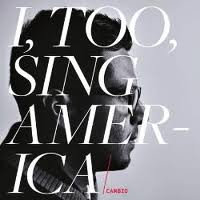 Cambio’s album title, I, Too, Sing America caught my eye for being named after a Langston Hughes poem (his answer to Walt Whitman’s work, “I Hear America Singing”). Cambio’s music caught my ear, too, thanks to his talk with Ignacio Palmieri on KPOO last week. With allusions to illusions, references to referendums, and tracks built on layers upon sound bites, scratch noises, and clips of speeches, Cambio’s point of view is progressive to the max, and that powerful voice is at the center of the mix.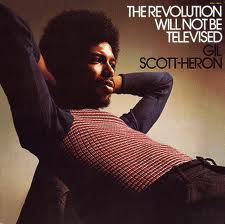
 Denise Sullivan