Buffy Sainte-Marie is one of the central figures in Keep on Pushing: As unique musically as she is direct lyrically, Sainte-Marie was born on the Piapot Cree Indian reservation in Saskatchewan and adopted by a family in Maine. She says that as a child she was artistic innately, as well by necessity. Befriended by a Narragansett couple who lived near her family in Maine, it was from them she learned about cultural handcrafts and kindness. “They didn’t sit around and give me Indian lessons,” she said, “But on the other hand, they didn’t chase me away.” As a young student, Sainte-Marie was drawn to philosophy and religion, while she simultaneously developed her musical side, as a folk performer. Her unique vibrato and innovative song style are what first drew me to finding out more about her story; what I found, moved me to the core, from the volume of hardship and turmoil she described, to her refusal to study war, which landed her among Nixon’s enemies. “I don’t think many people, even today, understand how much blacklisting has gone on of artists in the record business,” she says. In the face of the hassles, Sainte-Marie continued to innovate, as an electronic musician as well as a computer-based visual artist. Committed to teaching, to passing on what was given freely to her as well as what she fought to achieve, Sainte-Marie’s work still offers a pointed critique of war, greed, injustice and the anti-people policies that impact indigenous people all over this land.
Debora Iyall is one of the artists directly descended from Sainte-Marie’s example of native creativity: A singer, a songwriter, a poet, and a visual artist, Iyall’s story also unfolds throughout Keep on Pushing, beginning with her time as a teenager during the Indians of All Tribes’ Occupation of Alcatraz. Her punk-rooted style bears little resemblance to Sainte-Marie’s folk roots (Iyall was most influenced by Patti Smith), but a close connection to arts education and her roots in the Cowlitz tribe made her a unique presence in San Francisco art-punk band, Romeo Void. Iyall had the guidance of elders—her mother and the Natives she met at pow-wows and on Alcatraz—who supported her creative discoveries. “I felt like I had these little nuggets of information or culture to hang on to,” she said. Today, Iyall exudes confidence in her work as a performer and visual artist and is also a teacher and advocate, for artists of all colors and dimensions.
I was honored and humbled to have been allowed access to the lives of both Debora Iyall and Buffy Sainte-Marie—two women whose works have uplifted and inspired, not only their brothers and sisters native to the Americas, but their fellow artists and anyone who’s ever been broke or hungry, tired, or cast aside, and helped them to keep on keeping on: Their complete stories are told in Keep on Pushing.
“For those of us who are progressive, who believe the City of San Francisco should work for everyone, it’s a difficult time to be at City Hall…it’s a difficult time to be in that building,” said Supervisor David Campos over the weekend as he helped to launch Vision SF, a grassroots group primed to reclaim San Francisco from the forces of greed, corruption and narcissism that have poisoned municipal waters.
Representing the Mission, the City’s Latino cultural district and locus of its housing crisis, Supervisor Campos brought the additional dimension of the broken immigration system to the event conceived as a pre-election housing initiative forum. Referring to Donald Trump scapegoating immigrants following a recent murder committed by an undocumented person here, Campos cleaved to San Francisco’s sanctuary city status and pressed to keep local law enforcement out of the business of immigration. “Our sanctuary policy already says we’re not going to tolerate criminal activity,” underscored Campos. “No human being is illegal and every human being regardless of immigration status has human dignity.”
Intended to rally grassroots community organizations and free range citizens and spur them into a cohesive voting block for this election, there wasn’t much talk of San Francisco’s homeless population, though the ballot’s housing initiatives perhaps imply a way toward that solution too. Propositions A, F, I, J and K concern affordable housing, regulating Airbnb, pausing development of market-rate housing, protecting legacy businesses and using city-owned surplus land respectively—and were elaborated on by the Housing Rights Committee’s Sara Shortt, former assemblyman and supervisor Tom Ammiano, lifelong human rights advocate Cleve Jones and artist Roberto Hernandez (who learned to organize directly from Cesar Chavez). The activists were joined by committed singer-songwriter Tom Heyman, young filmmakers Joe Talbot and Jimmie Fails, comedian Mike Evans, and poet laureate, Alejandro Murguía, among others. A clip of Alexandra Pelosi’s new film, San Francisco 2.0, was to be screened but Vision-SF co-founder David Talbot announced that venture capitalist Ron Conway succeeded in scaring HBO and the filmmaker’s family from showing the film and attending the event (not exactly a good portent for the region that sparked the Free Speech movement).
Talbot and co-host, former supervisor and housing rights activist Christina Olague presided over the program that generally advocated coalition building across race, age, and economic lines. Addressing the need to include young, exploited tech workers in the movement for economic and housing justice, Cleve Jones invoked the name of his friend Harvey Milk which brought the crowd to a eerie hush. “It’s over,” Jones remembered, as he recalled the moment of seeing the slain body of Milk being removed from City Hall, “All I could think was, “it’s over’,” he said. Though as night fell and the streets filled with San Franciscans from all walks of life, candles lit to mourn the fallen at the evening’s march and vigil in 1978, Jones found a way to be inspired to push forward. “This is just the beginning,” he said, and it was that message he impressed on the crowd who left with house signs and a renewed spirit of solidarity.
Meanwhile, across town, thousands of San Franciscans and tourists reveled in Golden Gate Park while musicians, many with counter-culture roots of their own, entertained at the annual three-day music festival sponsored by deceased private equity investor, Warren Hellman. Mega-producer T Bone Burnett used his stage time to speak truth to power: “Who’s going to call this darkness, darkness. Somebody’s got to locate the bomb, dot com.” The founders and members of Vision-SF are trying, man, but they’re going to need a whole lotta help from their friends.
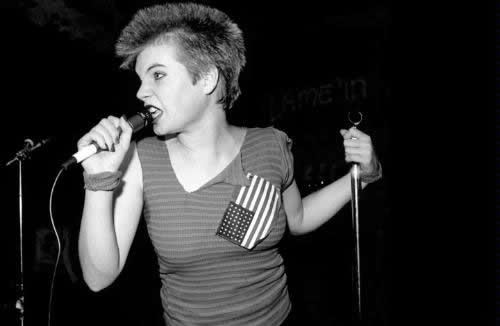
Among reasons to like Bernie Sanders, he supports the ERA and the Paycheck Fairness Act, he advocates for increasing minimum wage, has commited to expanding health and reproductive rights, and believes that childcare, preschool, and parental leave should be available to all Americans, not just a privileged few. While I don’t know where punk rocker Alice Bag stands on Bernie Sanders, I recently heard her perform “Equality in the USA” with Frightwig in San Francisco at the Punk Renaissance, a week long festival organized by Punk Rock Sewing Circle, former punk rockers committed to social justice. Interestingly, Sanders has ties to punk rock, when as mayor of Burlington, he approved the Mayor’s Youth Office and punk gathering spot, 242 Main. Not only do I think there could be a valuable meeting of the minds here– as in a coalition of punk rockers for Sanders– but Bag’s powerful punk performance once again reminded me of my generation’s musical ability to change hearts and public opinion in fundamental ways. Read entire article at
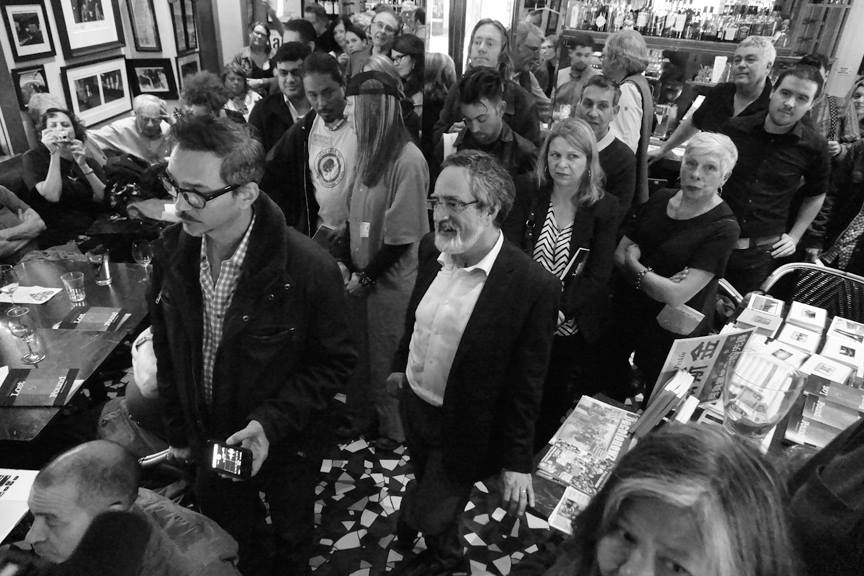
Cafe Zoetrope in North Beach was overflowing on Monday evening with politically engaged artists, writers, and neighbors gathered to support Aaron Peskin, candidate for Supervisor. A longtime affordable housing advocate and former chair of the SFDCCC, Peskin termed out of his Supervisor’s seat in 2008, but a return to the Board representing District Three could mean a restoration to sanity in the City’s legislative chamber if he succeeds in ousting the Ed Lee appointee, Julie Christensen.
The following is an extract from, Keep on Pushing, Black Power Music From Blues to Hip Hop, a perhaps unlikely source for a chapter featuring a mini, concise history of punk rock, with a San Francisco-bias. It’s a subject I’ve been interested in since Patti Smith’s Horses reached me in the Summer of 1976. On September 24, I will be among the panelists at SF Punk Renaissance for Punk: What Went Wrong…or Right?a discussion on the music and movement that inspired my generation.
All over the world, youth were collectively inspired to take back rock and put it into the hands of their generation, and they did it themselves, without corporations or websites or even a whole lot of love behind them. They did it with spit, muscle, sweat, and even Sid Vicious’s blood, and a couple of copies of Raw Power between them.
“It seemed like it had to go back to the three-minute song, something immediate and direct,” says Buzzcocks’ Steve Diggle. “And from that people came alive again.”
Among punk rock’s targets was the comfortable numbness of quotidian life, partially provided by expensively produced (Pink Floyd, the Eagles, Steely, Dan, and Fleetwood Mac) and lightweight (James Taylor and Carly Simon) rock. The back-to-basics music style combined with the anti-authority philosophy meant punk was largely a scene without leaders, organization or infrastructure. It can’t be said enough that in the United States there was virtually no commercial airplay for the music and there was very little in the way of favorable aboveground rock press for it either. But self-starting had its own rewards.
“People gained confidence in who they were, even ourselves, even with all our insecurities,” says Diggle. “It wasn’t like we were the big show business act to come to entertain people, it was more like…These guys are the same as us,” he says. “It was real people singing about real things and when we go up on stage we just put on guitars and there’s no big act.”
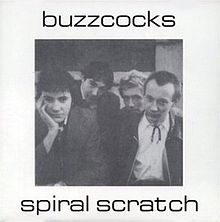
The do-it-yourself directive also lead to the resurgence and proliferation of the self-released seven-inch single, a format that had virtually become extinct with the popularization of seventies album rock. Buzzcocks was one of the first bands of the punk surge in England to release its own record, debuting with their Spiral Scratch EP in January of 1977. That spring the Ramones, with the Nerves and Pere Ubu, took the first murmurings of punk all across the USA. Though at the surface the punk pop of the Buzzcocks wasn’t political, “It was about personal politics,” explains Diggle. “It questioned things on many levels.” A song like “Autonomy” was about “self-rule.” And ‘Fast Cars’ was about the business of having a fast car,” he says.
Whether it was the words they sang—at once passionate and dispassionate—the way they sang them, or the fact that they sang them at all, songs like “Fast Cars” telegraphed something that went beyond the general speed limit: It confronted individuality and choice in a market-driven culture. “I hate fast cars!” was a radical statement, a rejection of values prized by a capitalist society.
The Ramones and the Sex Pistols have both been called the Johnny Appleseeds of punk, crisscrossing their respective countries and crossing the Atlantic while punk bands were breaking out like a spotty rash in places likely (London) and unlikely (Akron, Ohio). The Ramones brought their show to San Francisco’s Savoy Tivoli in 1976 and inspired a few artists and musicians to form bands of their own. The Sex Pistols did the same, bringing their show to the United States in early 1978, though the resulting media circus marked the end of the Pistols and the death of the early phase of punk. Penelope Houston’s band the Avengers opened the last-ever Sex Pistols show at Winterland in San Francisco. Less influenced by the entertainment of the Sex Pistols and the fun of the Ramones, Houston was a punk rocker of the battling kind. “I definitely recognized that Dylan was fighting against the things he saw as wrong but I would say my biggest singing influence would be Patti Smith,” she says.
The blank generation, a term coined by poet Richard Hell, found its muse, its voice, and its generation’s answer to Bob Dylan in Smith who released her first punk single in 1974. Having escaped a New Jersey childhood for the Chelsea Hotel, the young poet was also the girlfriend of photographer Robert Mapplethorpe and together they made art before she ever had the idea of making a record. Through the course of her bookstore clerk days and Max’s Kansas City nights, Smith emerged an androgynous, rock ‘n’ roll type, a person with more in common with Dylan and Keith Richards than any woman in rock.
Smith went to the San Francisco Bay Area in 1974—high Watergate season—to perform at Rather Ripped Records on the North Side of Berkeley campus. At the time, it was one of the few places you could buy an independent seven-inch record, what you might call the broadside of the late seventies. Smith’s new single was “Hey Joe,” the song with which Jimi Hendrix had ended his fateful set at Woodstock in 1969. The A-side began with a poem titled Sixty Days:
“Patty, you know what your daddy said, Patty, he said, he said, Well, sixty days ago she was such a lovely child , and how here she is with a gun in her hand.”
The Patty to whom she referred was Patricia Campbell Hearst, the newspaper heiress who’d taken the name Tania following her abduction by the Symbionese Liberation Army, an armed band of radicals, one group among a host of urban predators and terrorists raising hell in the Bay Area during the protracted aftermath of the Summer of Love. Tania had seemingly joined her captors in the class war struggle; “Hey Joe,” marked the official arrival of the new generation.
“I’m nobody’s million dollar baby, I’m nobody’s Patsy anymore, and I feel so free.”
From the decaying urbanscapes epitomized by the rotting Big Apple and the Rust Belt cities, and especially in hippie haven San Francisco, the post-sixties air of revolution hung heavy; Smith was the something new that blew in, wild, from the streets. San Francisco would remain the scene of more high times and inexplicable crimes throughout the decade. Home to the historic free speech and antiwar movement gatherings in the sixties, the Bay Area continued to be a place where minds behind movement and invention—whether high tech or slow food—converged. Its consecration as a gay mecca at that time is well known, while the role disco music played in gay liberation movement, and the role San Francisco played in the development of the punk rock movement, remain less documented. Perhaps these stories go some way toward providing necessary connections, as might the next section on punk’s relationship to reggae and hip hop.
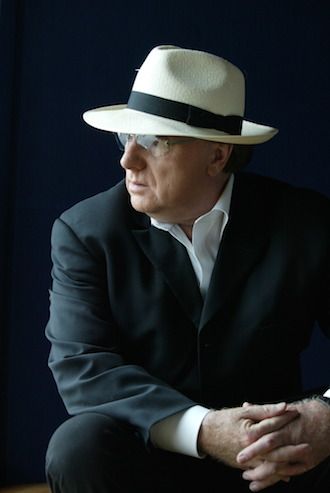
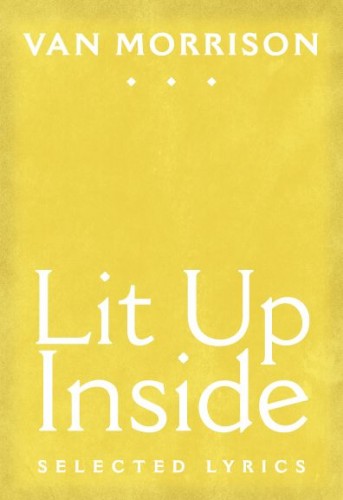
Written last summer for Blurt online, I’m reposting my review of Morrison’s collected lyrics, Lit Up Inside, on his 70th birthday.
During San Francisco’s notoriously punishing, foggy summers, there are those who find it extremely necessary to leave city limits and seek sun. On most days, it can be found shining a few short miles from the Golden Gate Bridge in Marin County, known the world over for its rich hippie homes of ’60s and ’70s rock stars. Though several decades have come and gone since Marin’s hot tub, water bed and peacock-feathered days, no matter how many times I drive north, down the long stretch of Sir Francis Drake Boulevard and through San Anselmo toward the beaches, my wandering mind inevitably lands on one question: How could Van Morrison stand it here?
As most Morrison fans know, the redwood chapter of the Irish singer-songwriter’s story was relatively brief, compared to his life in music, now in its sixth decade. And yet the period beginning when he emigrated to America (coinciding with family life and a big burst of creativity) and ending with his three-year hiatus from performing and recording (following the release of Veedon Fleece) is notable: Morrison’s Bay Area tenure produced such an abundance of songs there was a surplus; moreover, they were consistently played on the radio and still are, forever ensuring his place in local music history. Van’s persistent presence, in and on-the-air here, has not only soundtracked our lives: it’s in our DNA, the songs passed on by Irish immigrant and hippie parents, down to their tattooed love children (and their children), even when concerning faraway characters like the “Brown-Eyed Girl” or “Madame George.” Chances are whether you live in Nor Cal, North Carolina, or Northern Ireland you feel this connection too, yet the combination of deep personal content and universal humanity tucked inside Morrison’s songs was largely lost on me until reading the verses as a whole in Lit Up Inside (City Lights, 2014), the first published collection of his lyrics, handpicked by the songwriter.
It is within these songs—written in Morrison’s own Irish, romantic, soul code, with their carefully planned lines and studied notes and phrases, learned from jazz and classic blues and early rock ‘n’ roll—the story of Morrison’s life unfolds. Whether in the concise rock ‘n’ roll tale, “The Story of Them,” the timeless “Gloria,” “Lonely Sad Eyes,” and “Mystic Eyes,” or epics like “T.B. Sheets” and “Tore Down à la Rimbaud,” we get a glimpse into the people and places of Morrison’s heart, while every sha la la la la la la la la lala dee dah, every your eye, your eye, your eye, your eye, your eye, your eye rolls off his tongue with the same ease it does our own.
Rarely a day passes in which I don’t silently quote from Morrison’s common poems and prayers. In fact, it is from one song, “Domino,” from which I draw most phrases, using them as mantras (though not necessarily in the order they were written). Popping forth, just when I need them most, the words have saved me needless worry, disgrace, despair, disgust, and other things worse. Dig it: There’s no need for argument. Don’t want to discuss it. Think it’s time for a change. Get some heavy rest. There you go. Lord have mercy (not that Morrison holds a copyright on that bit).
While “Domino” isn’t included in Lit Up Inside (it doesn’t need to be), others that work similar magic are included: “Blue Money” (take five, honey—when this is all over, you’ll be in clover, etc.), “Saint Dominic’s Preview” (as we gaze out on, as we gaze out on), “The Great Deception,” (you don’t need it): All are timeless, rich, and just that much sweeter for capturing a place, a time, a San Francisco (or other locale) that no longer exists.
And then there are the hymns, so many of them, providing the book’s heft, conjuring the Almighty, and the music itself, and the ability to heal, whether for the skeptic in “Dweller on the Threshold” or the believer in “See Me Through Part II (Just a Closer Walk with Thee).” Literature serves as savior in “Summertime in England,” the book’s centerpiece, as Wordsworth, Coleridge, Blake and Eliot join the gospel of Mahalia Jackson in one hella hallelujah chorus. In his celebration of the oneness (“Rave on John Donne”) and explorations of the dark (“Tore Down à la Rimbaud”) there is an unremitting acceptance of the what is.
Even in what some might call the middle of the road songs, “Days Like This” and “Have I Told You Lately That I Love You,” Morrison provides simple truths served up by a full service songwriter, and the kind of warmth, companionship, healing, and love too often in short supply in real life (in spite of a reputation that has painted him as a bit gruff). Reading these works on the page I was not only mesmerized, but delivered to a place where recordings cannot always take me. I’m astonished by the depth of the songs, unaccompanied, and their illumination of the Vanness—of a life lived intentionally yet with imagination.
In keeping with the new tradition of assigning the task of writing about musicians to those who generally write on other subjects, Irish professor Eamonn Hughes, American poet David Meltzer and Scottish crime writer Ian Rankin provide the book’s largely personal front material. Both forwards include testimony of the ways in which music in general and Morrison specifically aid transition and provide a vision toward destinations unknown. All the contributions refer to Morrison’s Belfast past and soul while Meltzer makes a case for the Irish songman belonging to the City Lights family of outsider poets and dissidents. Though I had not previously given much thought to the idea of Morrison—maker of hit singles, taker of world tours and recognizable throughout the West and way beyond it—as an outsider, the songs compiled are certainly a validation that fitting in is for squares, being on trend is for the birds, and speaking one’s mind may not win you any popularity contests, but in the end, truth wins. Lit Up Inside is further evidence, as if more was needed, that Morrison’s burr takes us toward our own truths and serves as a guide for the weary and restless on their way home. An artist for the ages, his songs are timeless contributions to poetry, written and spoken word, and shall remain in the air, long after we’re gone and the very last foghorn blows.
A portion of this post originally appeared here as an obituary in July, 2011.It has been updated and amended as a remembrance.
Rare groove chasers know well the name Eugene McDaniels; his 1971 album for Atlantic, Headless Heroes of the Apocalypse is a standard-bearer for psychedelic soul/funk/jazz rhythms and is borrowed frequently for its samples (most famously by A Tribe Called Quest and the Beastie Boys). The album is a fierce statement of Black pride, anger, and frustration, equally powered by a super-soul fever, a yearning for world peace, and ultimately love. A showcase for McDaniels’s breadth as a composer, from folky singer-songwriter styles (“Susan Jane”) to proto-rap (“Supermarket Blues”), his strongest words are demonstrations of righteous indignation (“The Lord is Black, his mood is in the rain…he’s coming to make corrections”). His reward for creating such a unique piece of work was to have it recalled from the shelves and suppressed by Nixon’s White House; it remains a lost classic and is a story waiting to be told.
McDaniels is also the composer of “Compared to What,” the jazz-soul wartime protest made famous by Les McCann and Eddie Harris, a worldwide hit in 1969.
Born in Kansas City in 1935, McDaniels studied at the Omaha Conservatory of Music, and graduated from Omaha University. After forming a band in the 1950s, and singing with the McCann trio, he signed with Liberty Records and hit in 1961 with “A Hundred Pounds of Clay,” followed by five more Top 40 hits, including “Tower of Strength.” With six hit records to his credit, McDaniels turned his focus to writing (he worked closely with Roberta Flack and ultimately wrote her hit “Feel Like Making Love,” among others). Following the success of “Compared to What,” by the time he attempted to relaunch his solo career as a singing and songwriting artist with his 1970 album The Outlaw, McDaniels had developed an intensely personal and pointed new style and direction. Fearless with his melodies and in his verses, the instrumentation on his early ’70s companion albums was a wild combination of folk-funk: electric and acoustic bass brushed against guitar, drums, and piano. The arrangements combined with the lyrics to strike inner chords of deep recognition, touching places in the heart only music can reach. McDaniels injects each song with theatrical and emotional soul power, delivering the verses with a fascist-fighting folker’s impeccable style of oration. Incensed and confused by injustice, his notes echo and stretch, like the sound of someone losing his mind. His elegy for the genocide of America’s indigenous population, “The Parasite (For Buffy),” dedicated to Native American and folksinger Buffy Sainte-Marie, is a shining example of his dramaturgical song style that places his subjects in a social, political. and psychological context. But McDaniels’s revolution of the mind is a peaceful one; though he paints pictures of hell and all hell breaking loose, his narrator does not advocate use of violence as a solution. Rather, violence is portrayed as the problem.
In Keep on Pushing: Black Power Music From Blues to Hip Hop, I touched on McDaniels’s status as one of Nixon’s Enemies. It was in fact his story that in part inspired me to probe 50 years of freedom singing, and how resistance in song is received (or not) by a mass audience. I remain deeply curious on the subject, but when my faith in music and in people is lagging, I pull out Headless Heroes of the Apocalypse and find it restores and inspires me. Whatever darkness he’s describing, the McDaniels point of view remains poised and unique; his higher consciousness and keep-on-pushing spirit bleeds between the notes of each slyly rendered gospel-laced track. Years later, the Beastie Boys would turn to McDaniels, nicknamed the Left Rev McD, for a sample, as would the Afro-centric, conscious hip-hoppers, A Tribe Called Quest who used a piece of “Jagger The Dagger” throughout People’s Instinctive Travels and the Paths of Rhythm. John Legend and the Roots brought back a version of “Compared to What,” which was most recently updated by the trumpet player and bandleader Terence Blanchard (with E-Collective featuring PJ Morton).
Eugene McDaniels made it real—no comparison. Listen below to “Supermarket Blues,” his musical statement from 1971 on racial profiling, police violence, and white supremacy: It sounds as fresh as the day it was recorded.
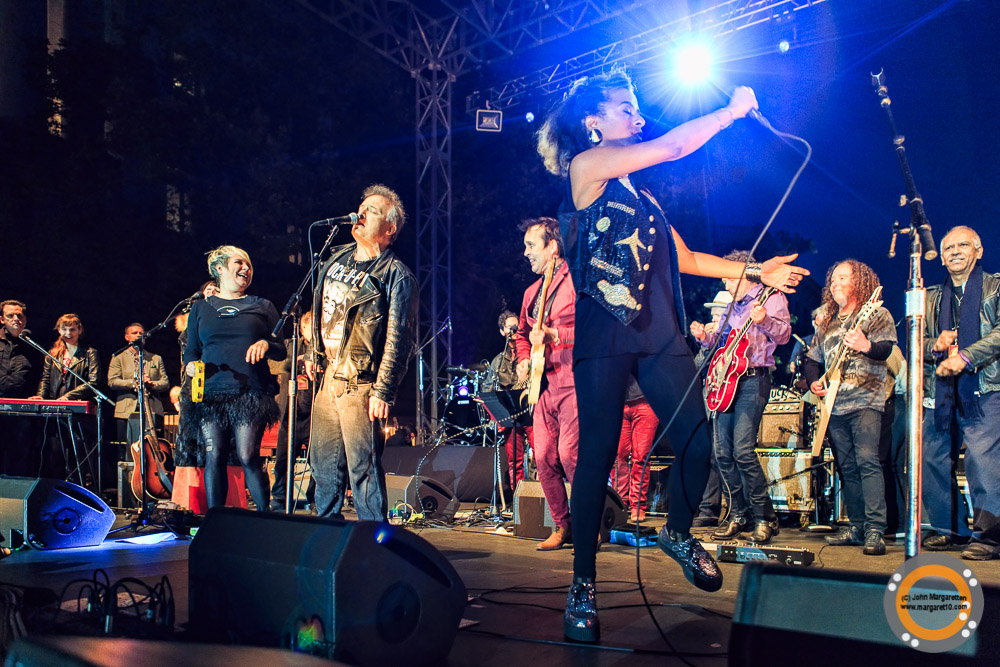
San Francisco–“That was for librarian Cynthia Hurd, murdered two nights ago for being black in America,” said Penelope Houston from the stage of Friday night’s musical Centennial Celebration of City Hall, punctuating her 38-year-old song, “The American In Me,” concerning the country’s culture of violence. Accompanied by Chuck Prophet and the Mission Express, Houston, who works by day as a city librarian and archivist, originally cut the song in 1977 with her history-making punk rock band the Avengers (they opened the last ever show by the Sex Pistols in San Francisco). Her remarks were welcome commentary at the mid-point of an impressive cross-generational revue assembled by Prophet to sing the songs of San Francisco…
Author David Talbot was making the rounds of San Francisco’s booksellers earlier this month during California Independent Bookstore Day, though the author of Season of the Witch and Brothers wasn’t promoting a new book; rather, he was using the community-oriented bookstore scene as a platform for his insider knowledge of City Hall to promote someone’s– anyone’s– significant bid for a mayoral run against Ed Lee in November. Talbot believes the need for new leadership in San Francisco is so dire, he joked he would run himself were it not for the personal and fiscal demands of entering a campaign. “I don’t want my wife to divorce me, which she said she would do if I did,” he laughed. Other potential candidates like former Mayor Art Agnos, State Senator Mark Leno, City Attorney Dennis Herrera, Public Defender Jeff Adachi, and State Assemblyman Tom Ammiano have all opted out of the race after being rumored or considered as runners; former Supervisor Aaron Peskin is also nolo contendere since announcing his wish to fill an opening on the Board of Supervisors (as its few remaining progressives term out). Talbot says there may be one more viable candidate out there for mayor, but his sources have made him promise not to drop any hints. Meanwhile, Lee and his chief backer, venture capitalist Ron Conway, will stop at nothing to win the race, so we shall expect the usual vulgarities once/if reasonable opposition appears on the scene before the June 9th nomination filing date.”So what we lack and need is leadership, a media outlet and a progressive think tank,” Talbot concluded from his opening remarks on Saturday at Modern Times Bookstore. Then he opened the floor to the assembled crowd of activists, attorneys, homeowners, and young journalists for comment. One long-time community organizer was near tears as she contemplated the prospect of another four years for Lee. “You think it’s bad now. We’ll all be gone by then,” she said, referring to the drift of long-time San Franciscans and natives away from the city they call home. “I share your pain, but don’t leave!” the author responded. “We need you here as an advocate.”
Talbot believes an institution devoted to educating future political leaders, as well as voters, would be a longer-term solution, and again he asked the crowd to speculate how such a venture, as well as a much-needed media outlet, could be funded. That question remained largely unanswered, though the one name that consistently comes up in these conversations is Marc Benioff, a tech billionaire and serious philanthropist intent on doing good with his wealth while encouraging others in his business to do the same.
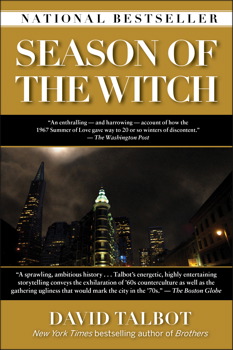
Talbot’s overview of city governance and his depth of understanding of public versus privately funded projects here, as well as of the more general role media plays in democratic society, is owed to his background as a journalist: He’s worked for Rolling Stone, Mother Jones, and the San Francisco Examiner, and he founded Salon, one of the Web’s earliest full-service magazines/news destinations. He was raised in Los Angeles, and his father, Lyle Talbot, was a founding member of the Screen Actors Guild. Talbot’s self-proclaimed obsession with the Kennedys led him to write Brothers: The Hidden History of the Kennedy Years; he followed with Season of the Witch, a cultural and political history of San Francisco and how it came to be the city it’s known to be versus the city that it is (on Saturday he revealed that Season of the Witch will be this fall’s One City One Book).
In recent years, Talbot has followed the story of changing San Francisco and has delivered a series of talks, including “Don’t Be a Stanford Asshole,” which implores new and future Stanford elite to be mindful of the dehumanizing nature of technology. A transcript made the rounds on the Internet earlier this year when it was picked up by 48 Hills, the one-man operation helmed by former SF Bay Guardian editor Tim Redmond, who Talbot believes is creating the kind of deep investigative journal we need in light of the long-insufficient San Francisco Chronicle, and in the absence of SF Bay Guardian, which was abruptly closed last year.
“We are a city, a world, in a boom and bust cycle,” asserts Talbot, and of that there is no doubt, though he notes the strange mood here as most of us await the next bust more fervently than more boom.
Last month even the historically nonpartisan 58th San Francisco International Film Festival got into the spirit of imminent change by hosting a program titled “Boomtown.” Redmond delivered a PowerPoint presentation providing an overview of the housing crisis in progress, though it was cultural expressions like Vero Majano’s heart-stopping spoken word and found film from the Mission District, Melorra and Melodie Greene’s interactive tribute to the LGBTQ/Black Lives Matter movement, and The Last Black Man In San Francisco, a film in the works by Talbot’s son Joe, which if seen by wider audiences could potentially change hearts and minds. Joe Talbot’s film is based on real events in the life of its co-writer and lead actor, Jimmy Fails (whom Talbot the elder considers an honorary son).
Fails’ African American family experience is the most extreme example of a community’s disproportionate displacement here, and yet the feelings speak for many of us when the character says, “My grandpa came West…Sometimes I feel there ain’t nothing left of me here. But where am I supposed to go? Ain’t shit west of here but water.” It’s an apt observation for a city lost at sea without a captain, but in these young filmmakers’ art and music (which Joe Talbot also composed) there is also light and hope–things we natives and transplants can all use a bit more of right now.
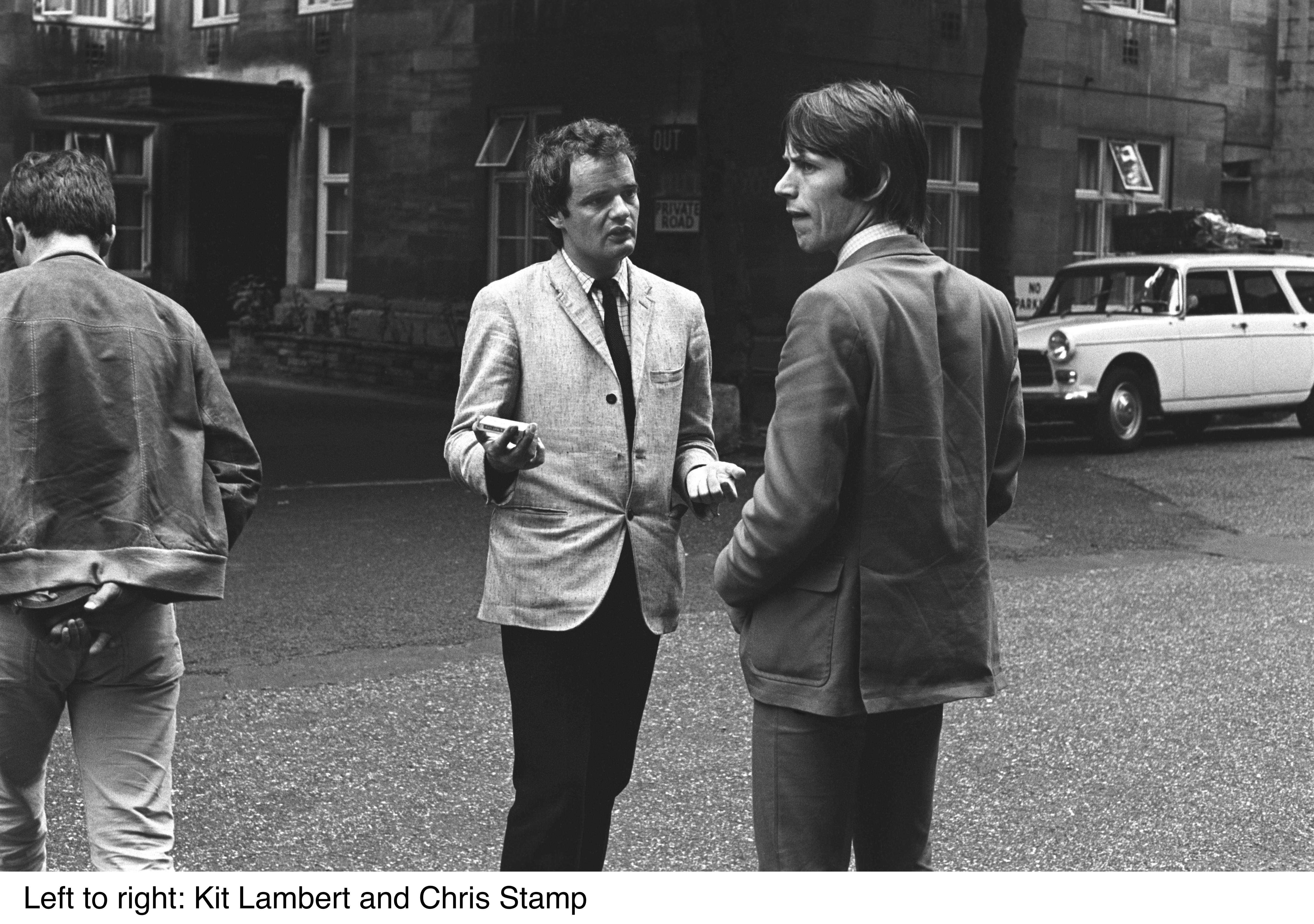
In the early ’60s, young British filmmakers Kit Lambert and Chris Stamp set out to find a rock band and make it the subject of a movie: To be crafted in French new wave style, they were set to upend the dominant narrative of grey, post-war England and capture the excitement of an explosive youth quake in progress.
“We didn’t know what we wanted, but we absolutely knew what we didn’t want,” says Chris Stamp in the new documentary, Lambert and Stamp. Their indescribable “it” made itself apparent at the Railway Hotel in 1964 where the High Numbers were at the center of a raucous and sweat-soaked Mod dance scene, yet instead of going through with their film, they turned the band—Roger Daltrey, Pete Townshend, John Entwistle and Keith Moon—into a palette for their expression. Fifty years later, Lambert and Stamp tells the largely untold story of the men Daltrey calls “the fifth and sixth members” of the Who.



 Denise Sullivan